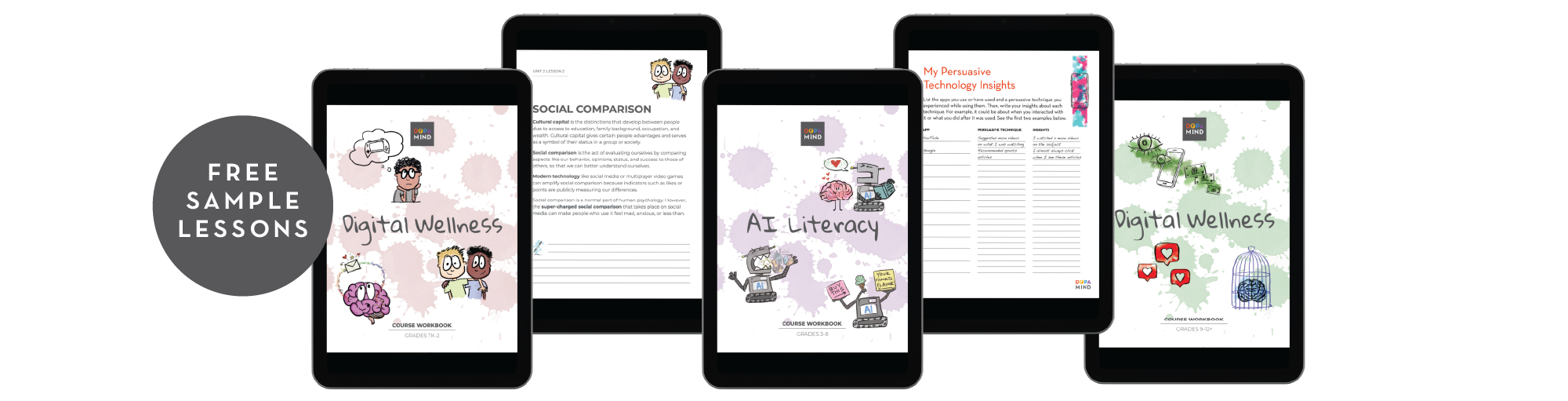
All-in-one course workbooks bring our expert-approved material to life with lessons and activities.
Our digital wellness, media literacy, and AI literacy workbooks are the perfect companion to DopaMind's course lessons and online courses, with teaching slides and activities in one clean, beautifully illustrated piece. Every purchase supports our nonprofit mission and enables us to provide free resources to classrooms in underserved communities.
✔️ Perfect for schools, homeschoolers, or families
✔️ Teaching slides and hands-on worksheets in one complete resource
✔️ Available beautifully pre-printed or as an instant self-print download
✔️ Use alone or alongside our online courses and course lessons
✔️ Self-printed versions available free to schools in financial need — just reach out
Pre-Printed
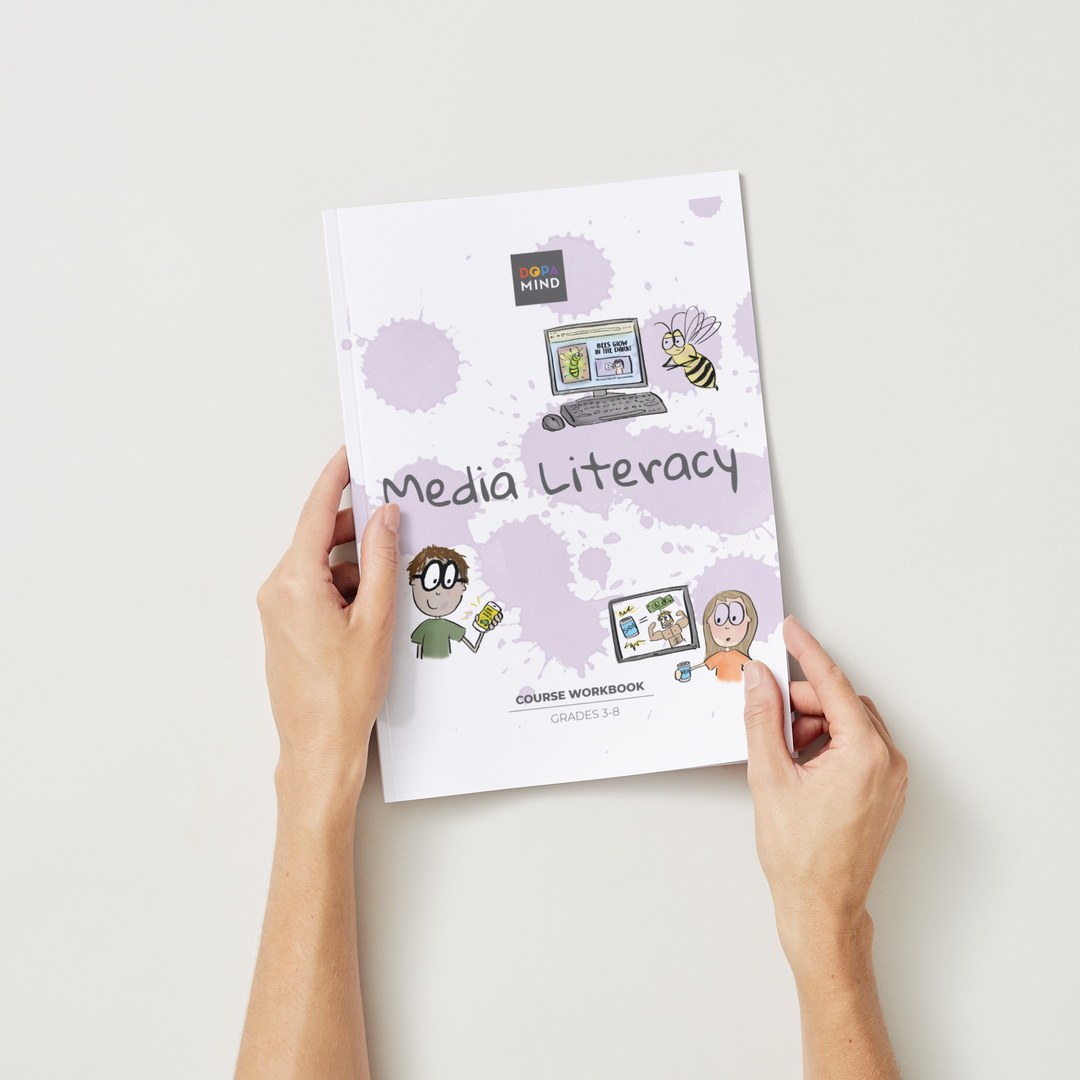
Our Media Literacy course — beautifully printed and bound, and shipped directly to you. Available as a single copy or save 25% off with a classroom pack of 30. Ordering for multiple classrooms or a whole school? Contact us for pricing.
Designed to follow Digital Wellness but equally effective as a standalone unit. Students develop the critical thinking skills needed to navigate today's information landscape — learning to analyze how media messages are constructed, spot misleading content and advertising, and apply a principle of inquiry to everything they see, hear, and share online. The ideal companion to our Media Literacy course lessons or online courses. Includes 8 presentation slides and 8 worksheets.
Identify different types of media messages and understand how they are produced.
Understand the verbal, aural, and visual aspects of media messages and how they shape perception of reality.
Differentiate between media sources and producers.
Navigate online content on search engines and websites and learn to differentiate between true and false information.
Understand the principle of inquiry regarding seen, heard, produced, and engaged content.use.
Download the full material guide for lower or middle school for a complete list of learning objectives.
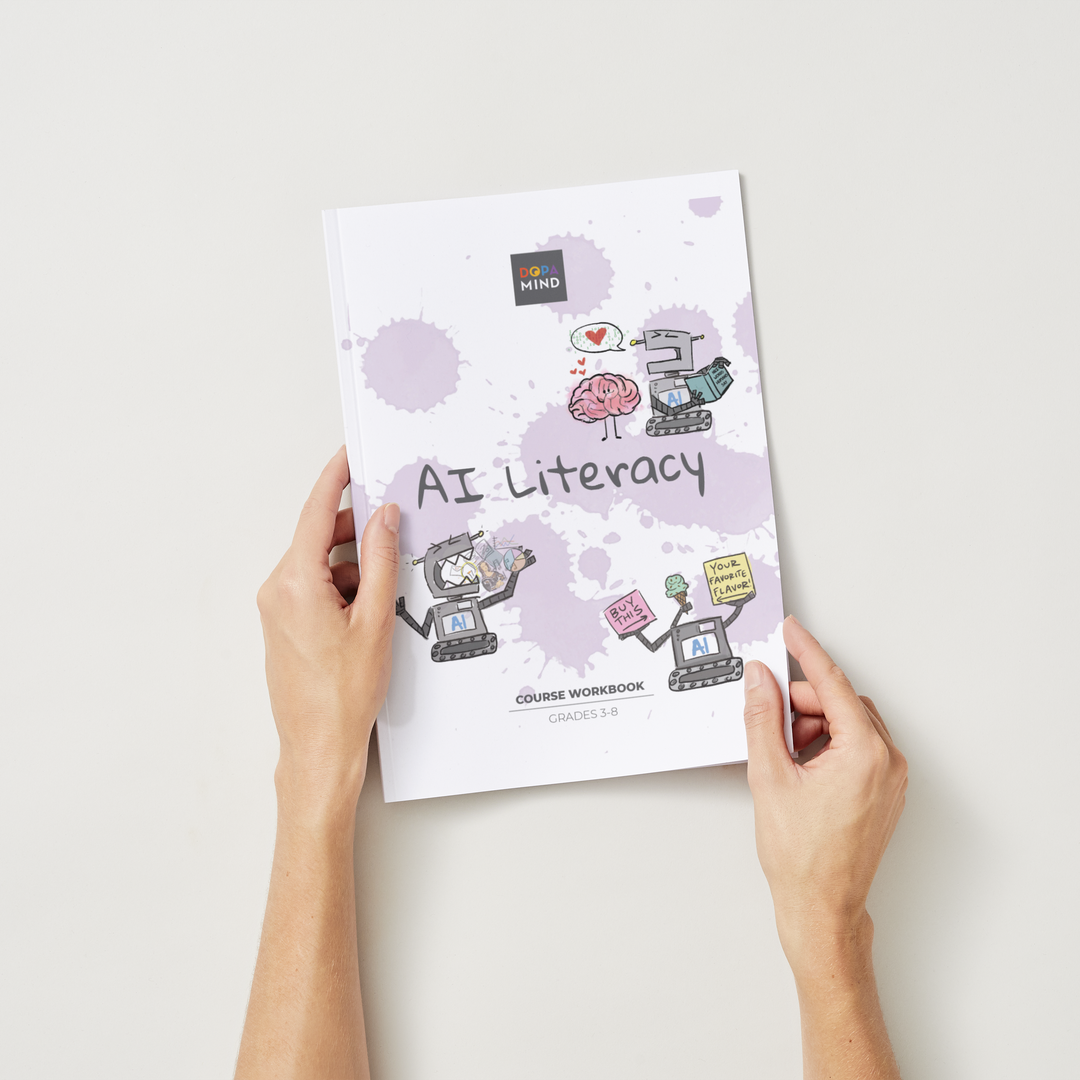
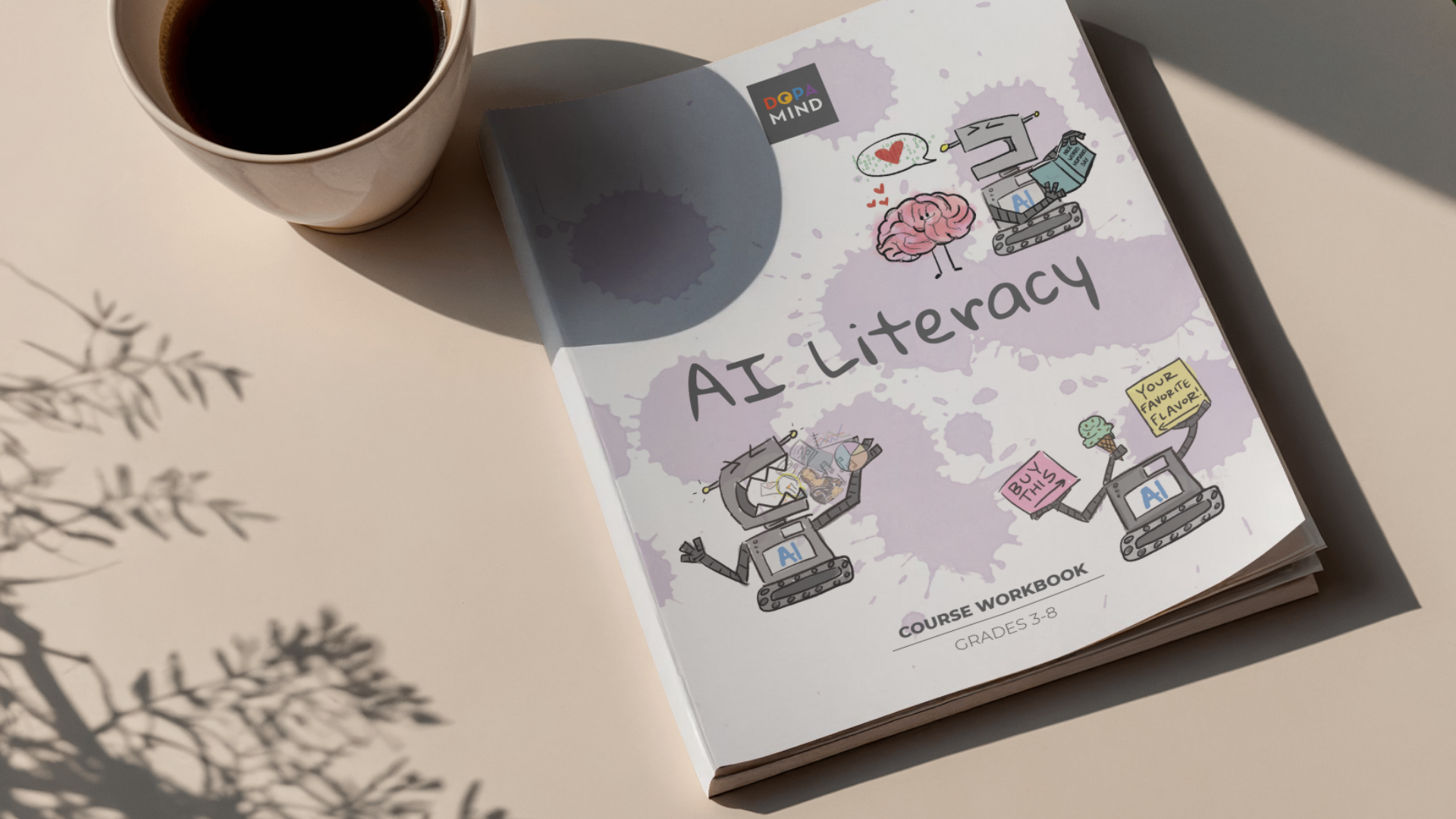
Our AI Literacy course — beautifully printed and bound, and shipped directly to you. Available as a single copy or save 25% off with a classroom pack of 30. Bulk orders also available — contact us for pricing.
Designed to follow Digital Wellness and Media Literacy courses but equally effective as a standalone unit. As artificial intelligence rapidly transforms childhood and education, students need a foundation to understand it. This unit covers what AI is, how it learns, its history, limitations, risks, and benefits — empowering students to think critically about AI's role in their lives and why adult guidance matters. The ideal companion to our AI Literacy course lessons or online courses. Includes 11 presentation slides and 11 worksheets.
Understand what AI is and how it differs from other technologies.
Identify where AI appears in daily life, from voice assistants to recommendation algorithms.
Learn the history of AI, how it's developed, and how it learns and evolves.
Recognize AI's limitations including hallucinations, bias, and mistakes.
Explore how AI helps and hurts individuals and society, including privacy concerns, job displacement, and impacts on thinking and relationships.
Learn why adult guidance is important when encountering AI tools and develop critical thinking skills for understanding AI's role in the world.
Download the full material guide for lower or middle school for a complete list of learning objectives.
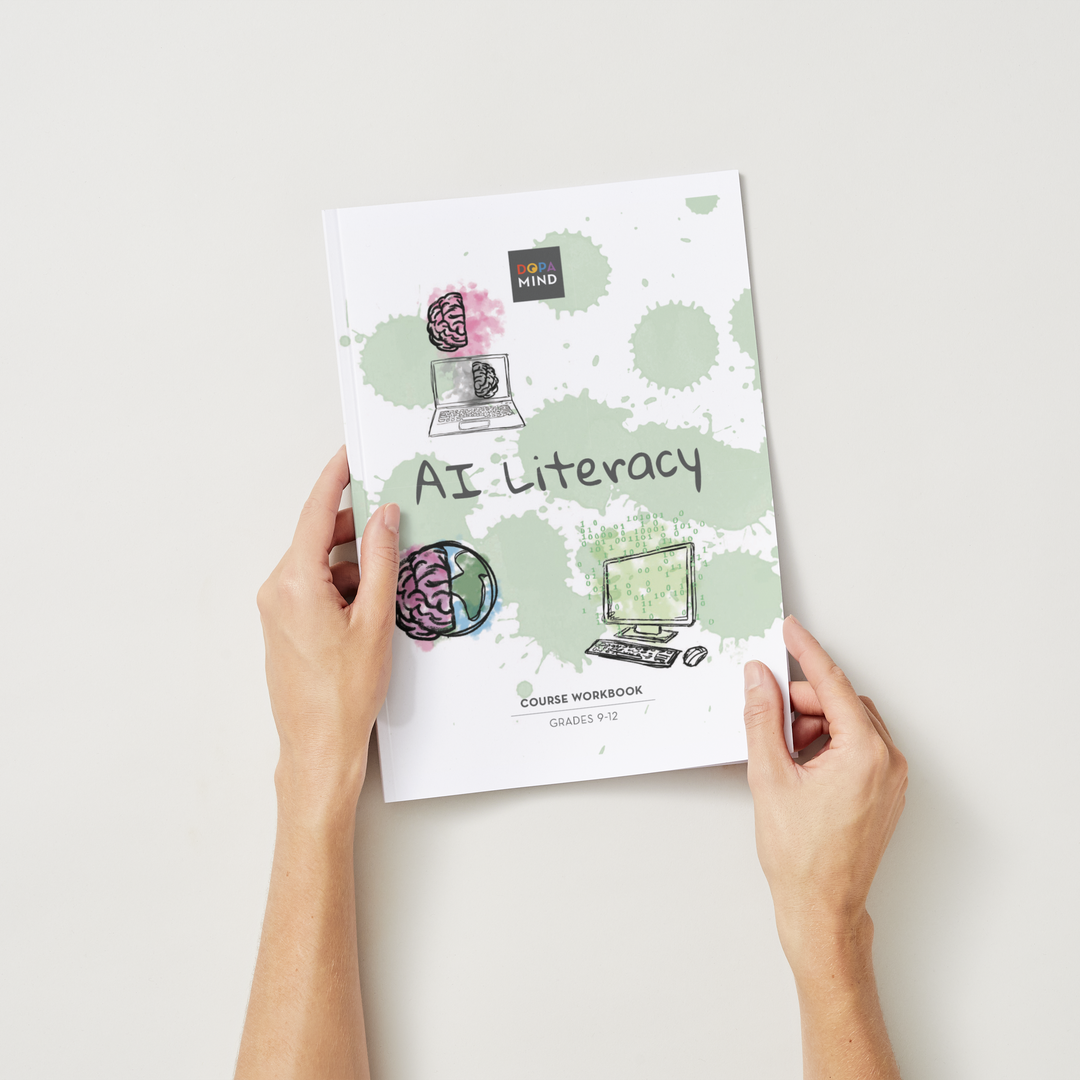
Our AI Literacy high school & college course — beautifully printed and bound, and shipped directly to you. Available as a single copy or save 25% off with a classroom pack of 30. Ordering for multiple classrooms or a whole school? Contact us for pricing.
Designed to follow Digital Wellness courses but equally effective as a standalone unit. As artificial intelligence rapidly transforms education and the workforce, high school and college students need more than a basic understanding of AI — they need the critical thinking and human skills to navigate it confidently. The ideal companion to our AI Literacy course lessons or online courses. Includes 23 presentation slides and 4 worksheets.
Understand what AI is and how it differs from traditional computer programs, and learn the history of AI and what made the rapid rise of generative AI possible.
Learn the difference between traditional, generative, and agentic AI and where each appears in today's world.
Understand how large language models are trained and why they demonstrate bias and hallucinations.
Explore how AI is helping society through medicine, science, and accessibility — and how it can hurt through job displacement, deepfakes, AI slop, and cognitive offloading.
Understand academic integrity and plagiarism risks of AI use in school and the workforce, and develop the critical thinking and human skills that will matter most in an AI-driven future.
Download the full material guide for a complete list of learning objectives.
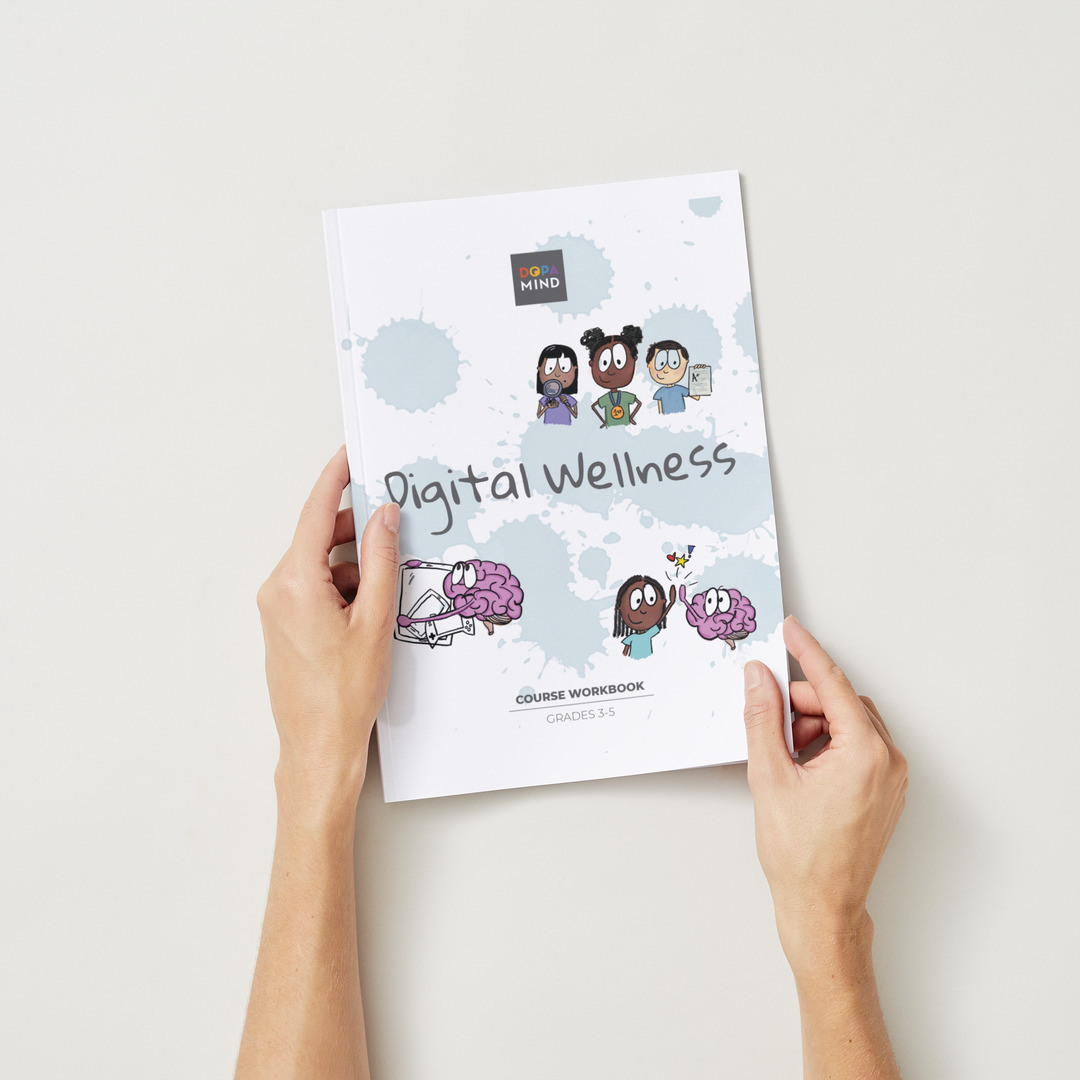
Our Digital Wellness Basics and Intermediate course — beautifully printed and bound, and shipped directly to you. Available as a single copy or save 25% off with a classroom pack of 30. Ordering for multiple classrooms or a whole school? Contact us for pricing.
Builds on Digital Wellness Grades TK–2 and adds our Intermediate unit designed specifically for the upper elementary years. From foundational brain science and dopamine to adolescent brain development, FOMO, social comparison, and identifying healthy vs. unhealthy tech habits. The ideal companion to our Digital Wellness course lessons or online courses. Includes 21 presentation slides and 21 worksheets.
Learn the key evolutionary principles behind technology use, define dopamine, and understand the pleasure and pain principle including signs of dopamine deficit and overload.
Understand key changes in the adolescent brain including the role of the amygdala and prefrontal cortex.
Explore social comparison, FOMO, and social exclusion and their connection to technology.
Recognize how excessive technology use affects attention, memory, and critical thinking and identify signs of problematic tech use.
Differentiate between healthy and unhealthy relationships with technology.
Download the full material guide for a complete list of learning objectives.
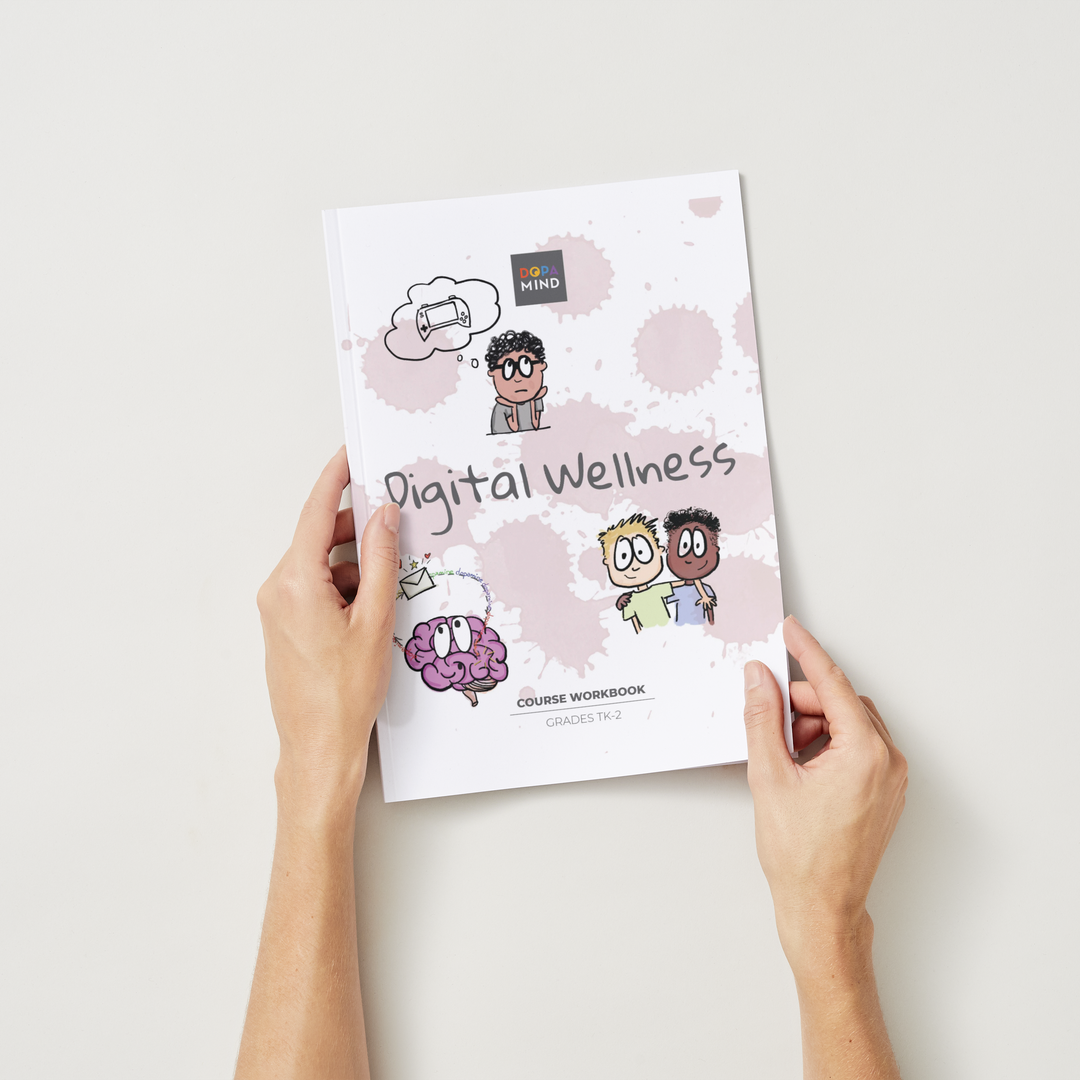
Our Digital Wellness Basics course — beautifully printed and bound, and shipped directly to you. Available as a single copy or save 25% off with a classroom pack of 30. Ordering for multiple classrooms or a whole school? Contact us for pricing.
The perfect introduction to brain science for young learners. Students explore how technology affects the developing brain, the role of dopamine, and what it means to make balanced, healthy choices — in a format designed specifically for early elementary. The ideal companion to our Digital Wellness course lessons or online courses. Includes 10 presentation slides and 10 worksheets.
Learn the key evolutionary principles that relate most to technology including light, play, and boredom.
Define dopamine and its role in the brain and understand the pleasure and pain principle, including signs of dopamine deficit and overload.
Understand how excessive screen time can impact dopamine levels and overall brain function.
Recognize the importance of balanced screen time with other activities.
Explore alternative activities supporting brain health such as physical exercise, mindfulness, and creative outlets.
Download the full material guide for a complete list of learning objectives.
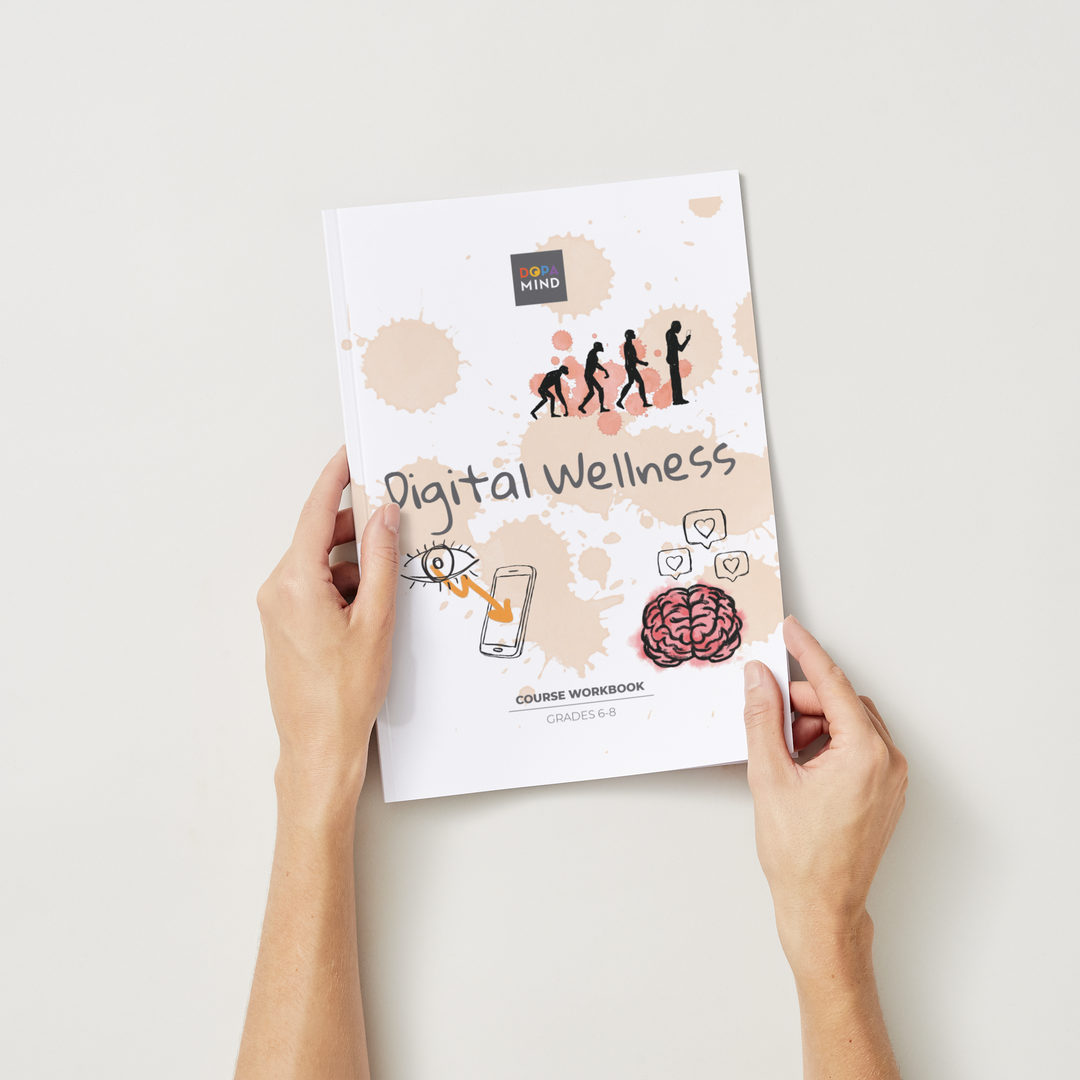
Our Digital Wellness Basics, Intermediate, and Advanced course — beautifully printed and bound, and shipped directly to you. Available as a single copy or save 25% off with a classroom pack of 30. Ordering for multiple classrooms or a whole school? Contact us for pricing.
Builds on Digital Wellness Grades TK–2 and 3–5 and adds our most in-depth unit yet — designed specifically for the middle school years. From foundational brain science to adolescent brain development, social media, video games, and the neurological effects of modern screen technology. The ideal companion to our Digital Wellness course lessons or online courses. Includes 42 presentation slides and 15 worksheets.
Learn the key evolutionary principles behind technology use, define dopamine, and understand the pleasure and pain principle including signs of dopamine deficit and overload.
Understand key adolescent brain changes including the role of the amygdala and prefrontal cortex and how technology intersects with FOMO, social comparison, and social exclusion.
Recognize how excessive technology use affects attention, memory, and critical thinking and identify signs of problematic tech use.
Learn the physical effects of modern screen technology, how it has evolved alongside adolescents, and how it affects learning and memory.
Explore the pros and cons of video games and social media, the differences between real and virtual relationships, and how gender and bias play into technology use.
Download the full material guide for a complete list of learning objectives.
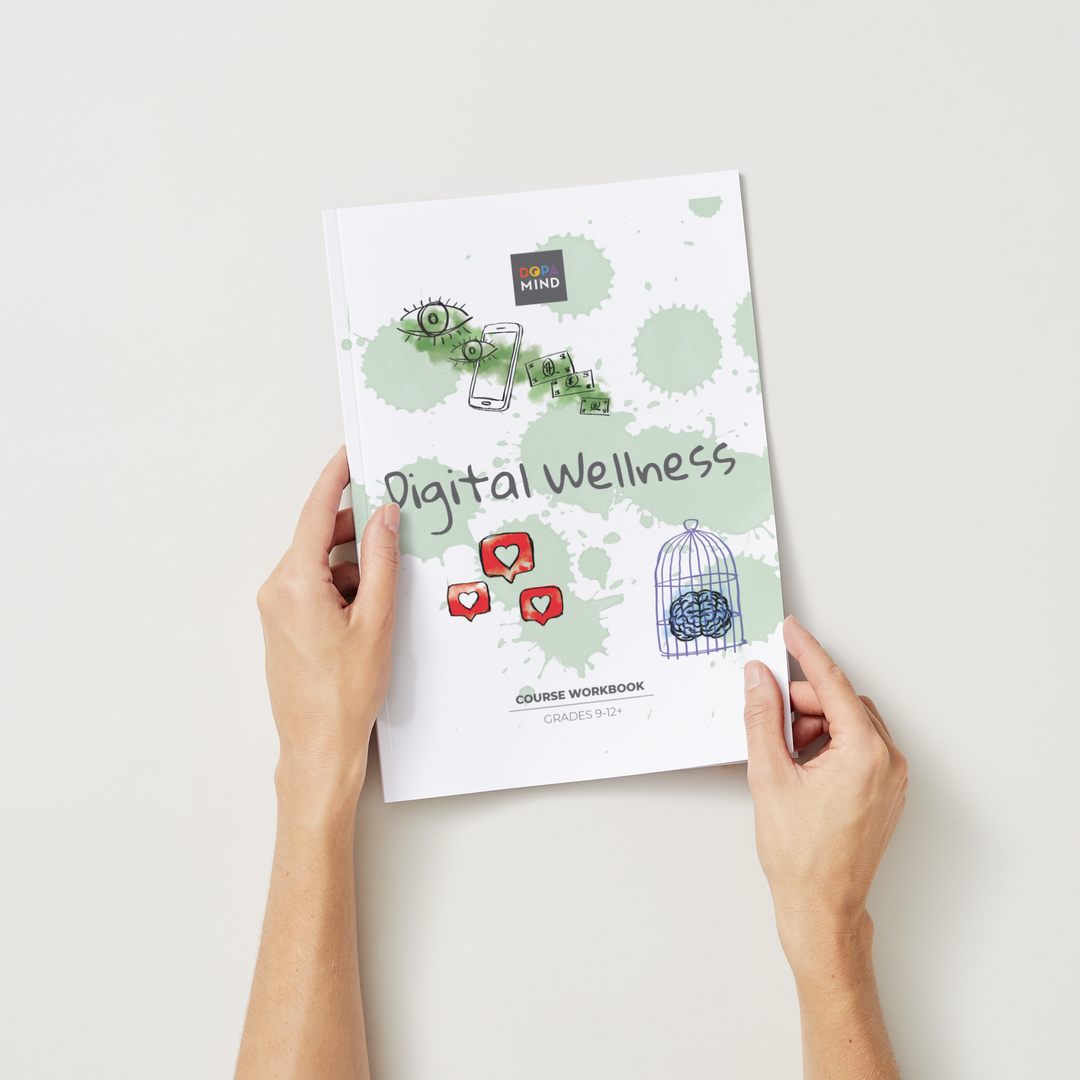
Our complete Digital Wellness course including Basics, Intermediate, Advanced, and Master material — beautifully printed and bound, and shipped directly to you. Available as a single copy or save 25% off with a classroom pack of 30. Ordering for multiple classrooms or a whole school? Contact us for pricing.
Builds on Digital Wellness Grades TK–2, 3–5, and 6–8 and adds our Master unit — our most sophisticated material, designed for high school and college students ready to think critically about technology's role in society. The ideal companion to our Digital Wellness course lessons or online courses. Includes 58 presentation slides and 18 worksheets.
Learn the key evolutionary principles behind technology use, define dopamine, and understand the pleasure and pain principle including signs of dopamine deficit and overload.
Understand key adolescent brain changes including the role of the amygdala and prefrontal cortex and how technology intersects with FOMO, social comparison, and social exclusion.
Recognize how excessive technology use affects attention, memory, and critical thinking and identify signs of problematic tech use.
Learn the physical effects of modern screen technology, how it has evolved alongside adolescents, and how it affects learning and memory.
Explore persuasive technology design, the attention economy, Big Tech legislation, loneliness, nomophobia, and what individuals and communities can do to create change.
Download the full material guide for a complete list of learning objectives.
Self-Printed
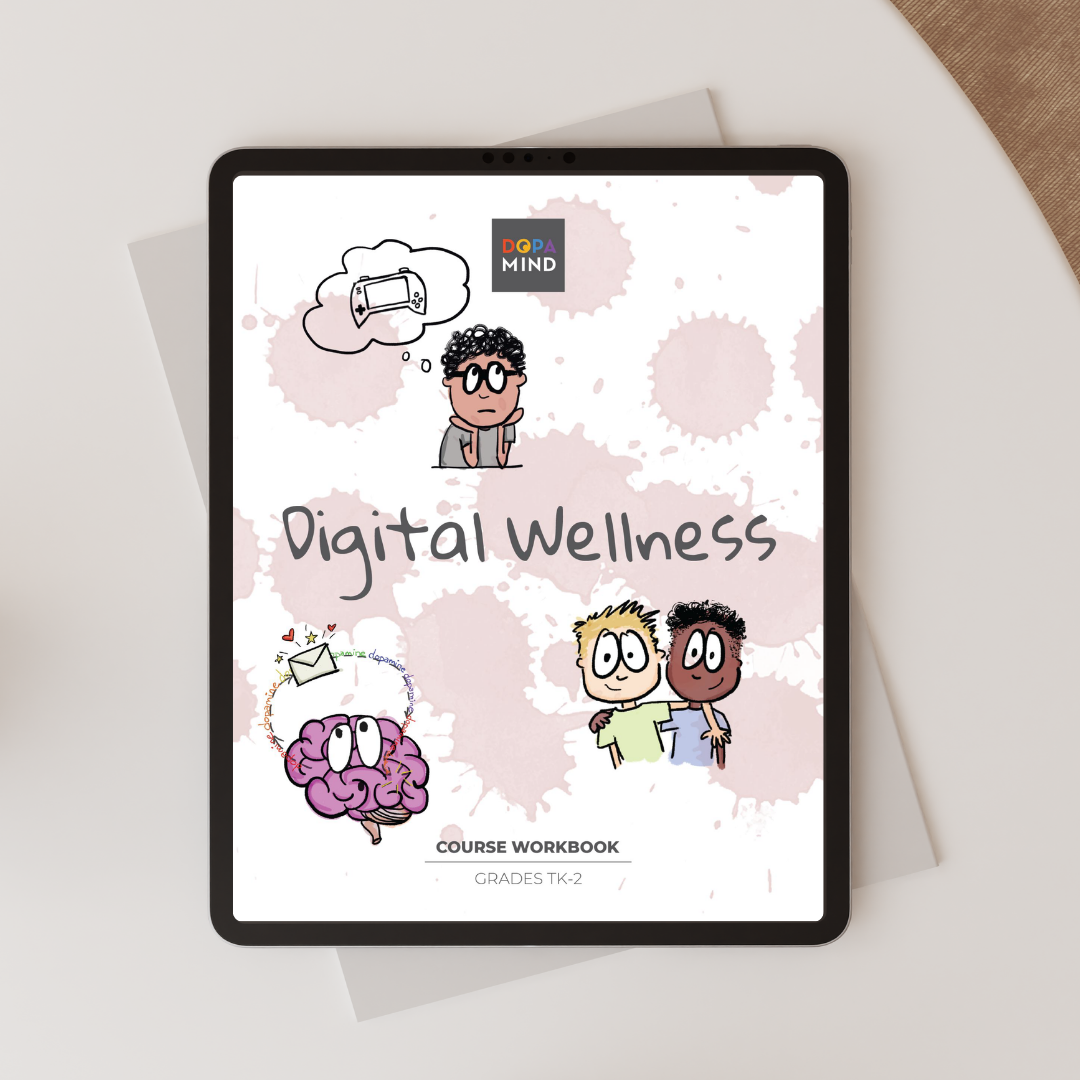
Our Digital Wellness Basics course workbook — lessons and activities combined into one download, for individual parents and homeschool families. Classroom and school license options also available.
The perfect introduction to brain science for young learners. Students explore how technology affects the developing brain, the role of dopamine, and what it means to make balanced, healthy choices — in a format designed specifically for early elementary. The ideal companion to our Digital Wellness course lessons or online courses. Formatted for seamless printing at home or at your local print shop. Includes 10 presentation slides and 10 worksheets.
Learn the key evolutionary principles that relate most to technology including light, play, and boredom.
Define dopamine and its role in the brain and understand the pleasure and pain principle, including signs of dopamine deficit and overload.
Understand how excessive screen time can impact dopamine levels and overall brain function.
Recognize the importance of balanced screen time with other activities.
Explore alternative activities supporting brain health such as physical exercise, mindfulness, and creative outlets.
Download the full material guide for a complete list of learning objectives.
Your purchase supports DopaMind's nonprofit mission — and if cost is ever a barrier, just ask. We believe every student deserves access to this education.
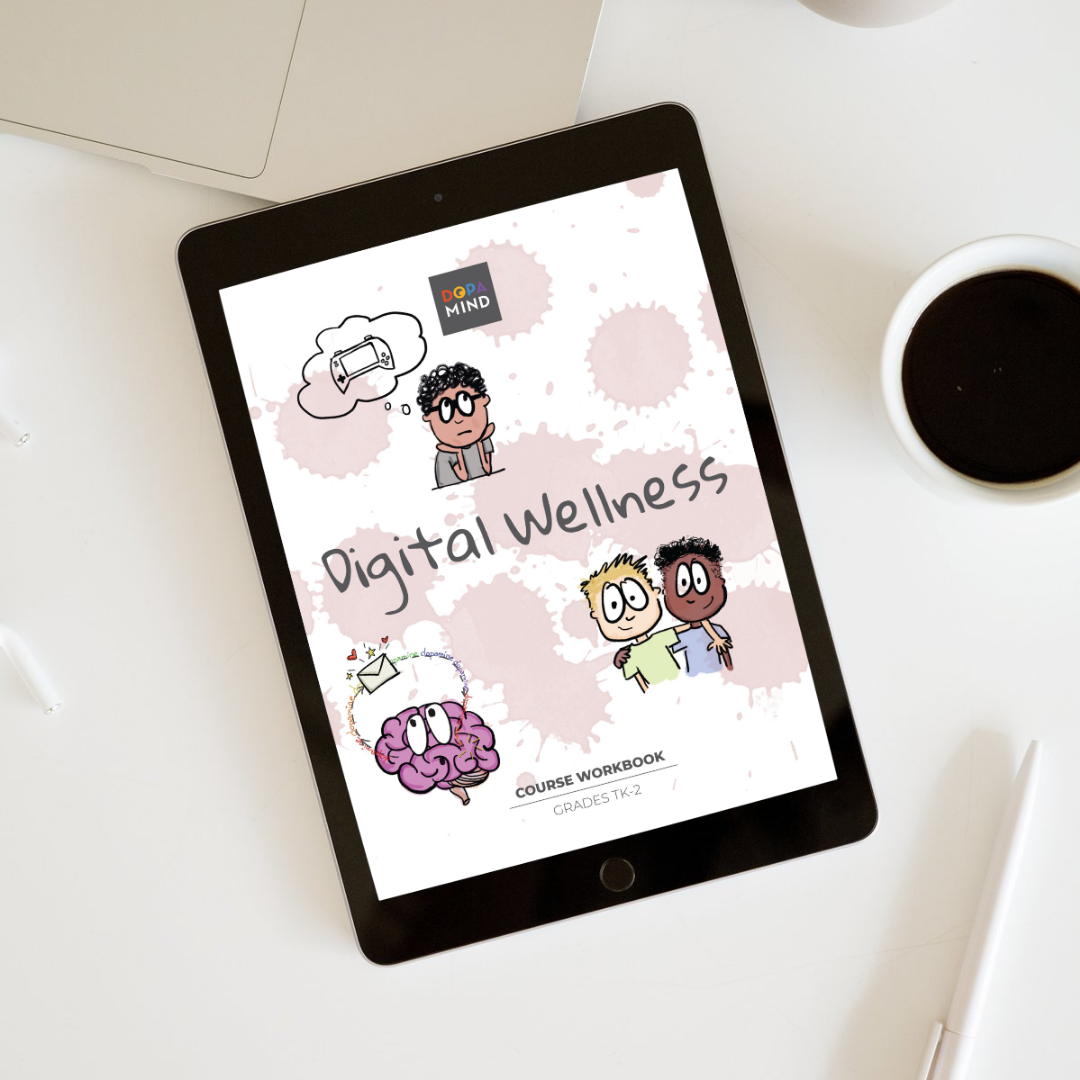
Our Digital Wellness Basics course workbook — lessons and activities combined into one download, for a single classroom. Personal and school license options also available.
The perfect introduction to brain science for young learners. Students explore how technology affects the developing brain, the role of dopamine, and what it means to make balanced, healthy choices — in a format designed specifically for early elementary. The ideal companion to our Digital Wellness course lessons or online courses. Formatted for seamless printing at home or at your local print shop. Includes 10 presentation slides and 10 worksheets.
Learn the key evolutionary principles that relate most to technology including light, play, and boredom.
Define dopamine and its role in the brain and understand the pleasure and pain principle, including signs of dopamine deficit and overload.
Understand how excessive screen time can impact dopamine levels and overall brain function.
Recognize the importance of balanced screen time with other activities.
Explore alternative activities supporting brain health such as physical exercise, mindfulness, and creative outlets.
Download the full material guide for a complete list of learning objectives.
Your purchase supports DopaMind's nonprofit mission — and if cost is ever a barrier, just ask. We believe every student deserves access to this education.
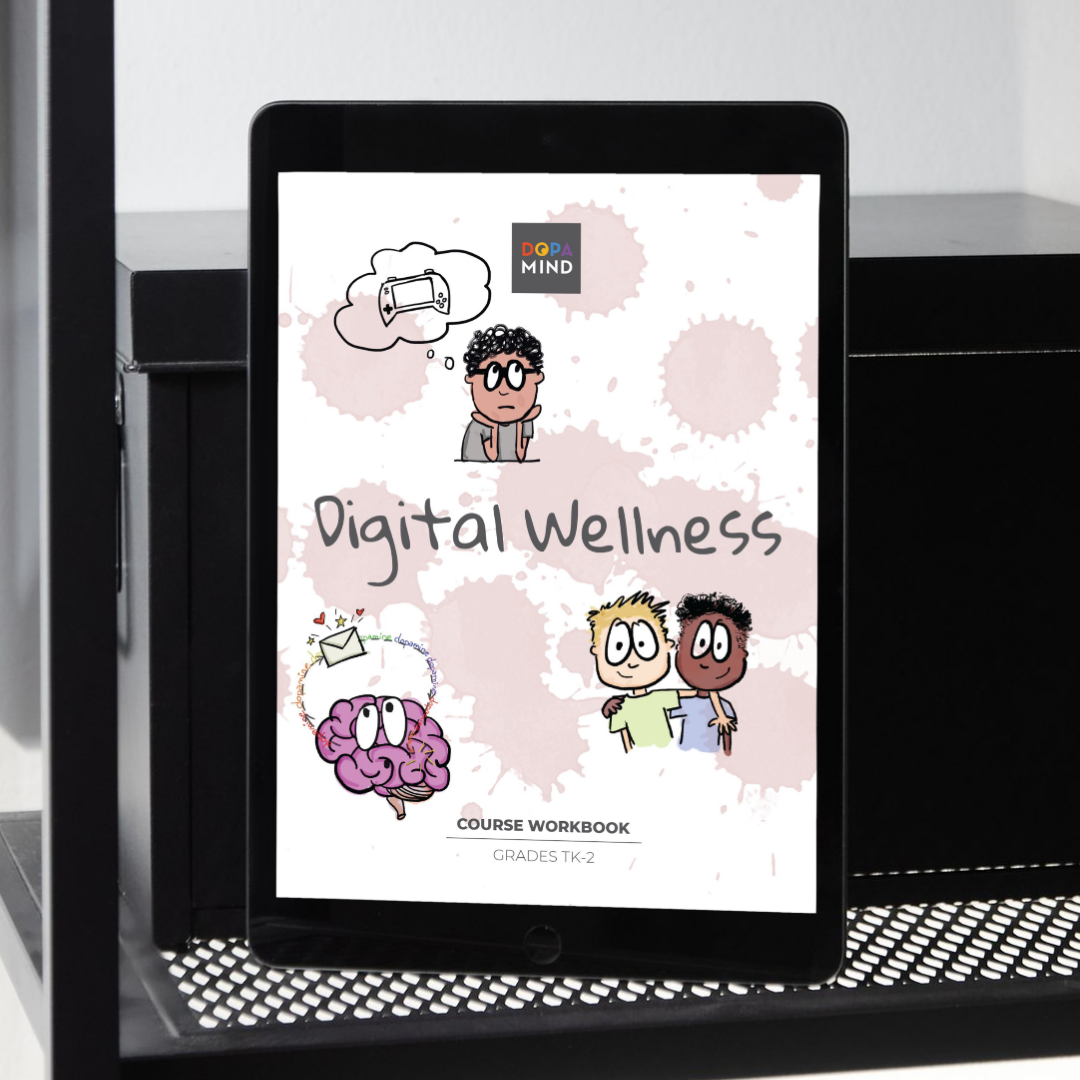
Our Digital Wellness Basics course workbook — lessons and activities combined into one download, for school-wide use across all classrooms. Personal and classroom license options also available.
The perfect introduction to brain science for young learners. Students explore how technology affects the developing brain, the role of dopamine, and what it means to make balanced, healthy choices — in a format designed specifically for early elementary. The ideal companion to our Digital Wellness course lessons or online courses. Formatted for seamless printing at home or at your local print shop. Includes 10 presentation slides and 10 worksheets.
Learn the key evolutionary principles that relate most to technology including light, play, and boredom.
Define dopamine and its role in the brain and understand the pleasure and pain principle, including signs of dopamine deficit and overload.
Understand how excessive screen time can impact dopamine levels and overall brain function.
Recognize the importance of balanced screen time with other activities.
Explore alternative activities supporting brain health such as physical exercise, mindfulness, and creative outlets.
Download the full material guide for a complete list of learning objectives.
Your purchase supports DopaMind's nonprofit mission — and if cost is ever a barrier, just ask. We believe every student deserves access to this education.
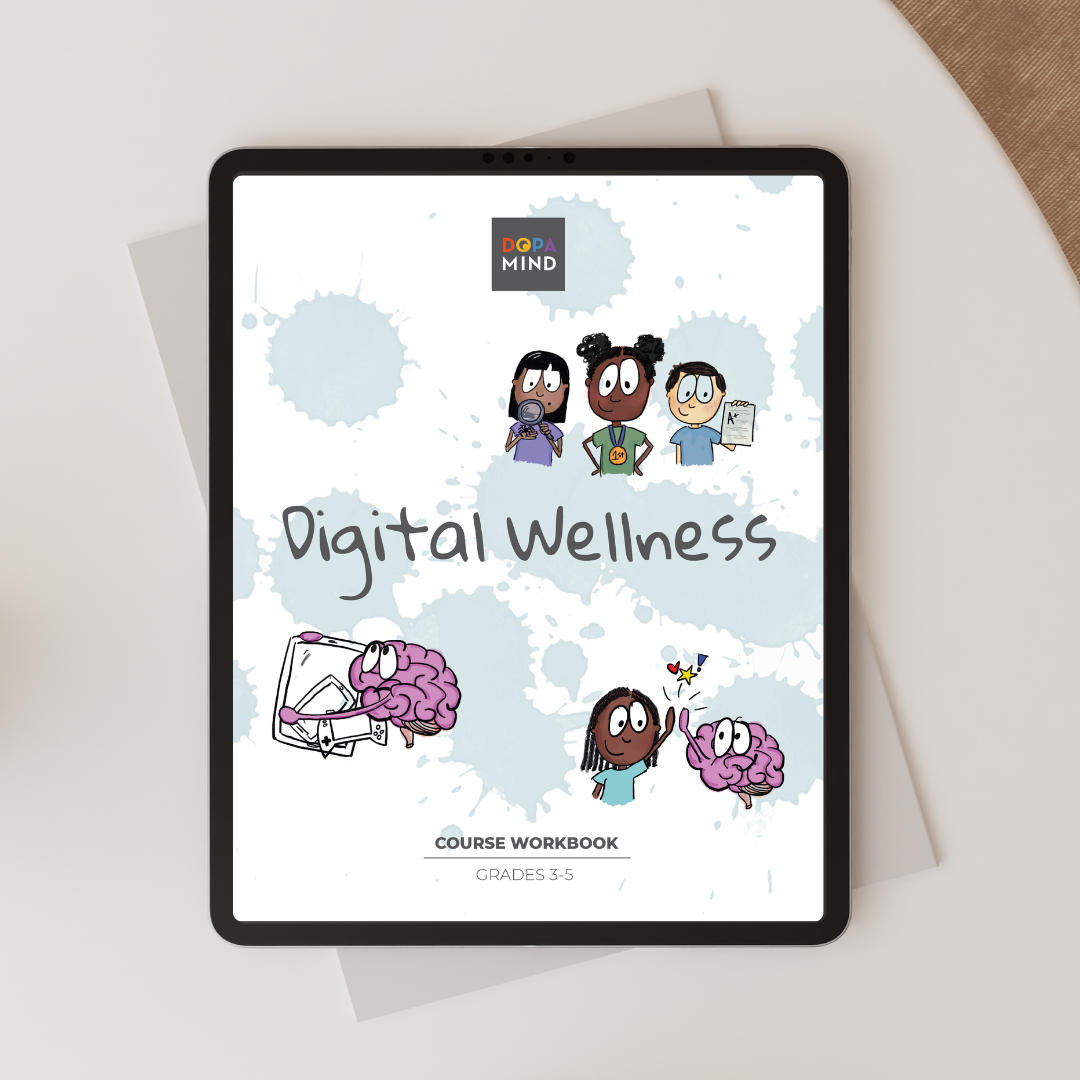
Our Digital Wellness Basics and Intermediate course workbook — lessons and activities combined into one download, for individual parents and homeschool families. Classroom and school license options also available.
Builds on Digital Wellness Grades TK–2 and adds our Intermediate unit designed specifically for the upper elementary years. From foundational brain science and dopamine to adolescent brain development, FOMO, social comparison, and identifying healthy vs. unhealthy tech habits. The ideal companion to our Digital Wellness course lessons or online courses. Formatted for seamless printing at home or at your local print shop. Includes 21 presentation slides and 21 worksheets.
Learn the key evolutionary principles behind technology use, define dopamine, and understand the pleasure and pain principle including signs of dopamine deficit and overload.
Understand key changes in the adolescent brain including the role of the amygdala and prefrontal cortex.
Explore social comparison, FOMO, and social exclusion and their connection to technology.
Recognize how excessive technology use affects attention, memory, and critical thinking and identify signs of problematic tech use.
Differentiate between healthy and unhealthy relationships with technology.
Download the full material guide for a complete list of learning objectives.
Your purchase supports DopaMind's nonprofit mission — and if cost is ever a barrier, just ask. We believe every student deserves access to this education.
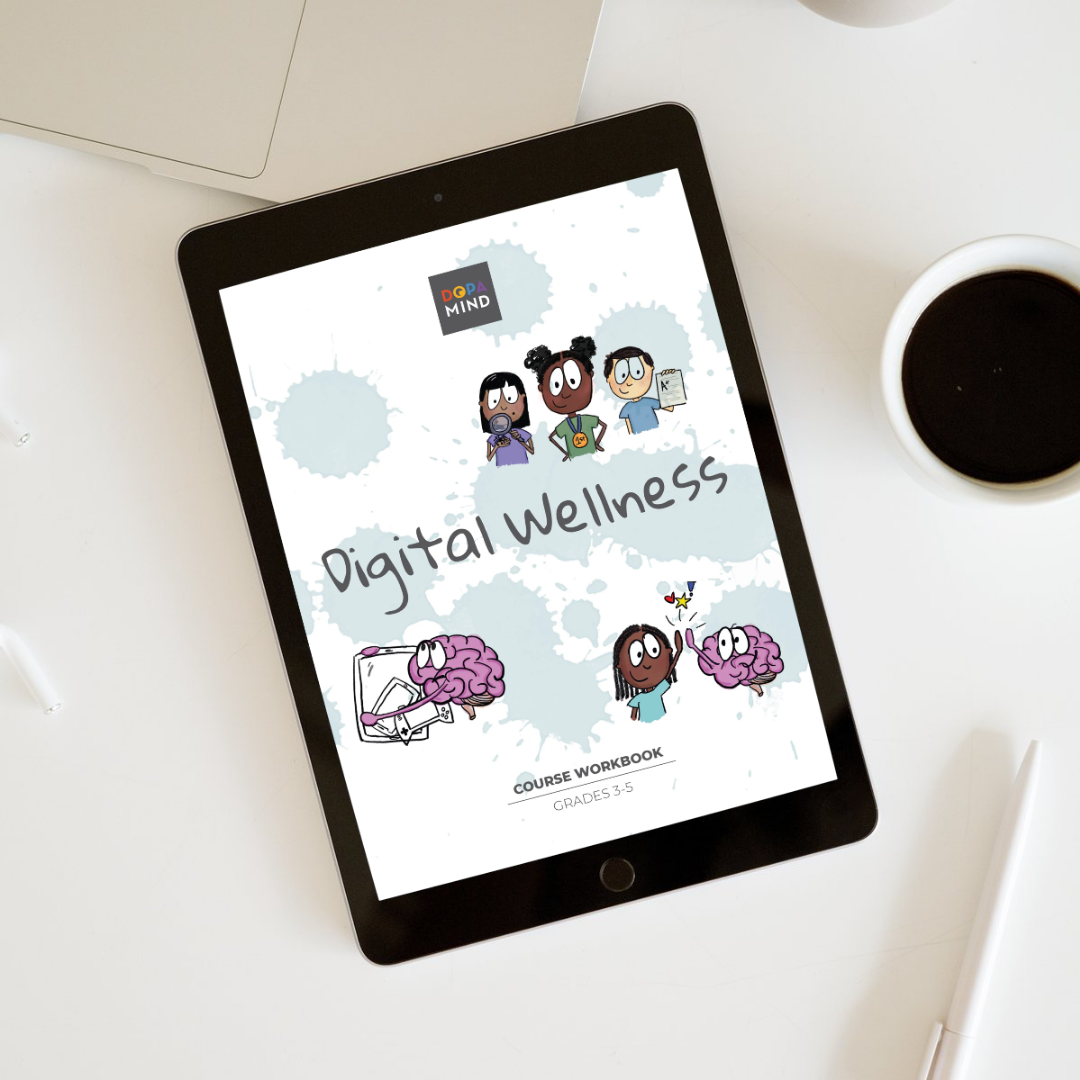
Our Digital Wellness Basics and Intermediate course workbook — lessons and activities combined into one download, for a single classroom. Personal and school license options also available.
Builds on Digital Wellness Grades TK–2 and adds our Intermediate unit designed specifically for the upper elementary years. From foundational brain science and dopamine to adolescent brain development, FOMO, social comparison, and identifying healthy vs. unhealthy tech habits. The ideal companion to our Digital Wellness course lessons or online courses. Formatted for seamless printing at home or at your local print shop. Includes 21 presentation slides and 21 worksheets.
Learn the key evolutionary principles behind technology use, define dopamine, and understand the pleasure and pain principle including signs of dopamine deficit and overload.
Understand key changes in the adolescent brain including the role of the amygdala and prefrontal cortex.
Explore social comparison, FOMO, and social exclusion and their connection to technology.
Recognize how excessive technology use affects attention, memory, and critical thinking and identify signs of problematic tech use.
Differentiate between healthy and unhealthy relationships with technology.
Download the full material guide for a complete list of learning objectives.
Your purchase supports DopaMind's nonprofit mission — and if cost is ever a barrier, just ask. We believe every student deserves access to this education.
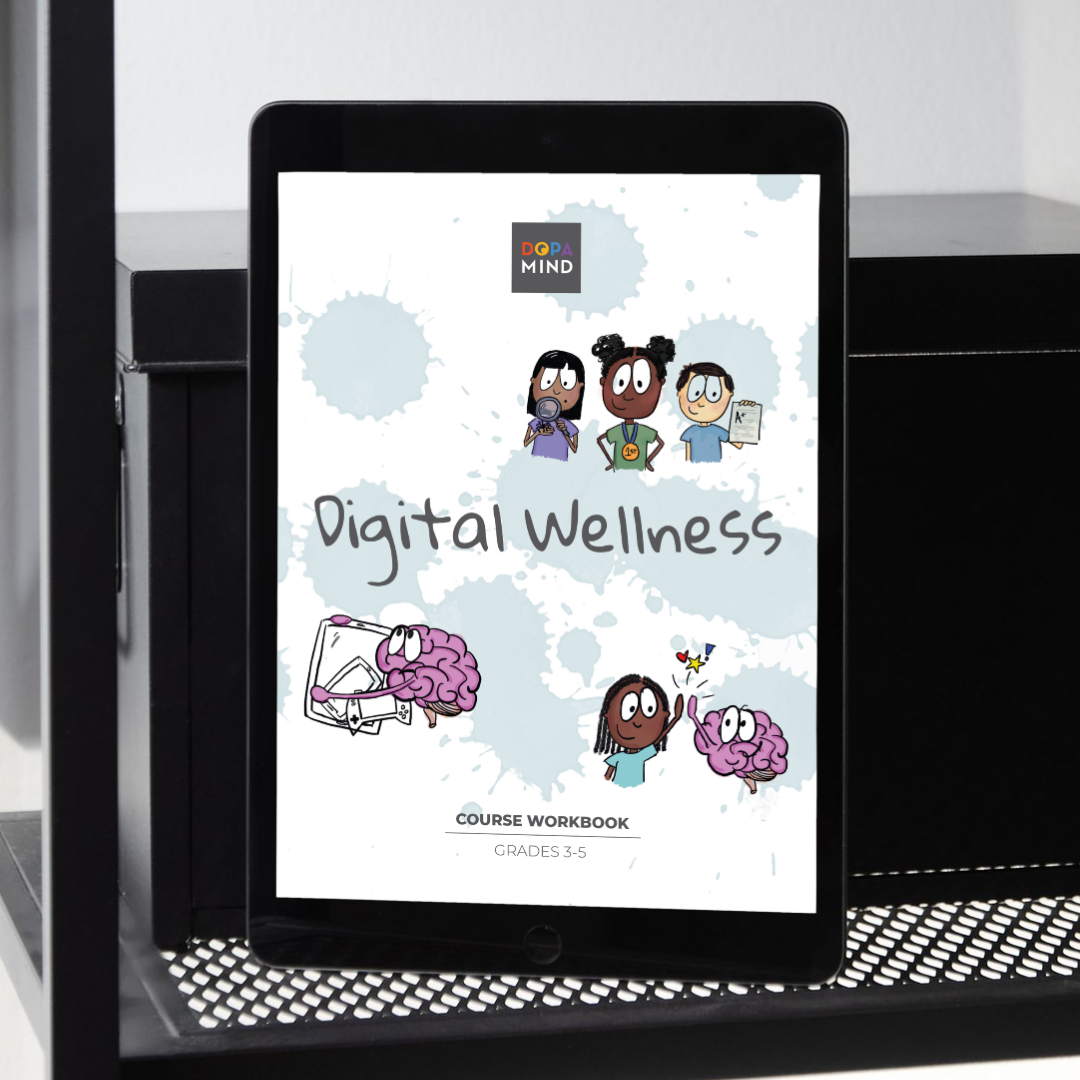
Our Digital Wellness Basics and Intermediate course workbook — lessons and activities combined into one download, for school-wide use across all classrooms. Personal and classroom license options also available.
Builds on Digital Wellness Grades TK–2 and adds our Intermediate unit designed specifically for the upper elementary years. From foundational brain science and dopamine to adolescent brain development, FOMO, social comparison, and identifying healthy vs. unhealthy tech habits. The ideal companion to our Digital Wellness course lessons or online courses. Formatted for seamless printing at home or at your local print shop. Includes 21 presentation slides and 21 worksheets.
Learn the key evolutionary principles behind technology use, define dopamine, and understand the pleasure and pain principle including signs of dopamine deficit and overload.
Understand key changes in the adolescent brain including the role of the amygdala and prefrontal cortex.
Explore social comparison, FOMO, and social exclusion and their connection to technology.
Recognize how excessive technology use affects attention, memory, and critical thinking and identify signs of problematic tech use.
Differentiate between healthy and unhealthy relationships with technology.
Download the full material guide for a complete list of learning objectives.
Your purchase supports DopaMind's nonprofit mission — and if cost is ever a barrier, just ask. We believe every student deserves access to this education.
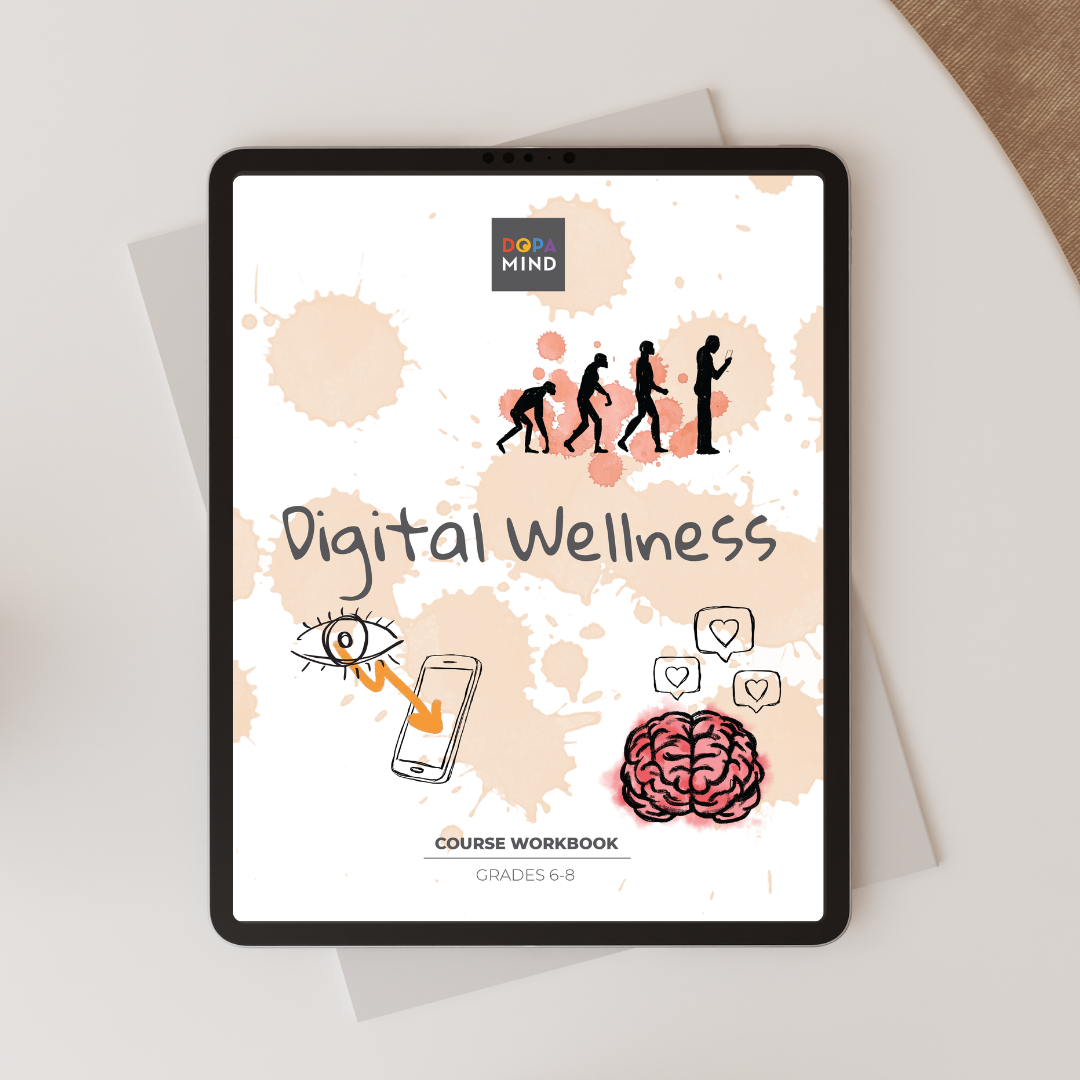
Our Digital Wellness Basics, Intermediate, and Advanced course workbook — lessons and activities combined into one download, for individual parents and homeschool families. Classroom and school license options also available.
Builds on Digital Wellness Grades TK–2 and 3–5 and adds our most in-depth unit yet — designed specifically for the middle school years. From foundational brain science to adolescent brain development, social media, video games, and the neurological effects of modern screen technology. The ideal companion to our Digital Wellness course lessons or online courses. Formatted for seamless printing at home or at your local print shop. Includes 42 presentation slides and 15 worksheets.
Learn the key evolutionary principles behind technology use, define dopamine, and understand the pleasure and pain principle including signs of dopamine deficit and overload.
Understand key adolescent brain changes including the role of the amygdala and prefrontal cortex and how technology intersects with FOMO, social comparison, and social exclusion.
Recognize how excessive technology use affects attention, memory, and critical thinking and identify signs of problematic tech use.
Learn the physical effects of modern screen technology, how it has evolved alongside adolescents, and how it affects learning and memory.
Explore the pros and cons of video games and social media, the differences between real and virtual relationships, and how gender and bias play into technology use.
Download the full material guide for a complete list of learning objectives.
Your purchase supports DopaMind's nonprofit mission — and if cost is ever a barrier, just ask. We believe every student deserves access to this education.
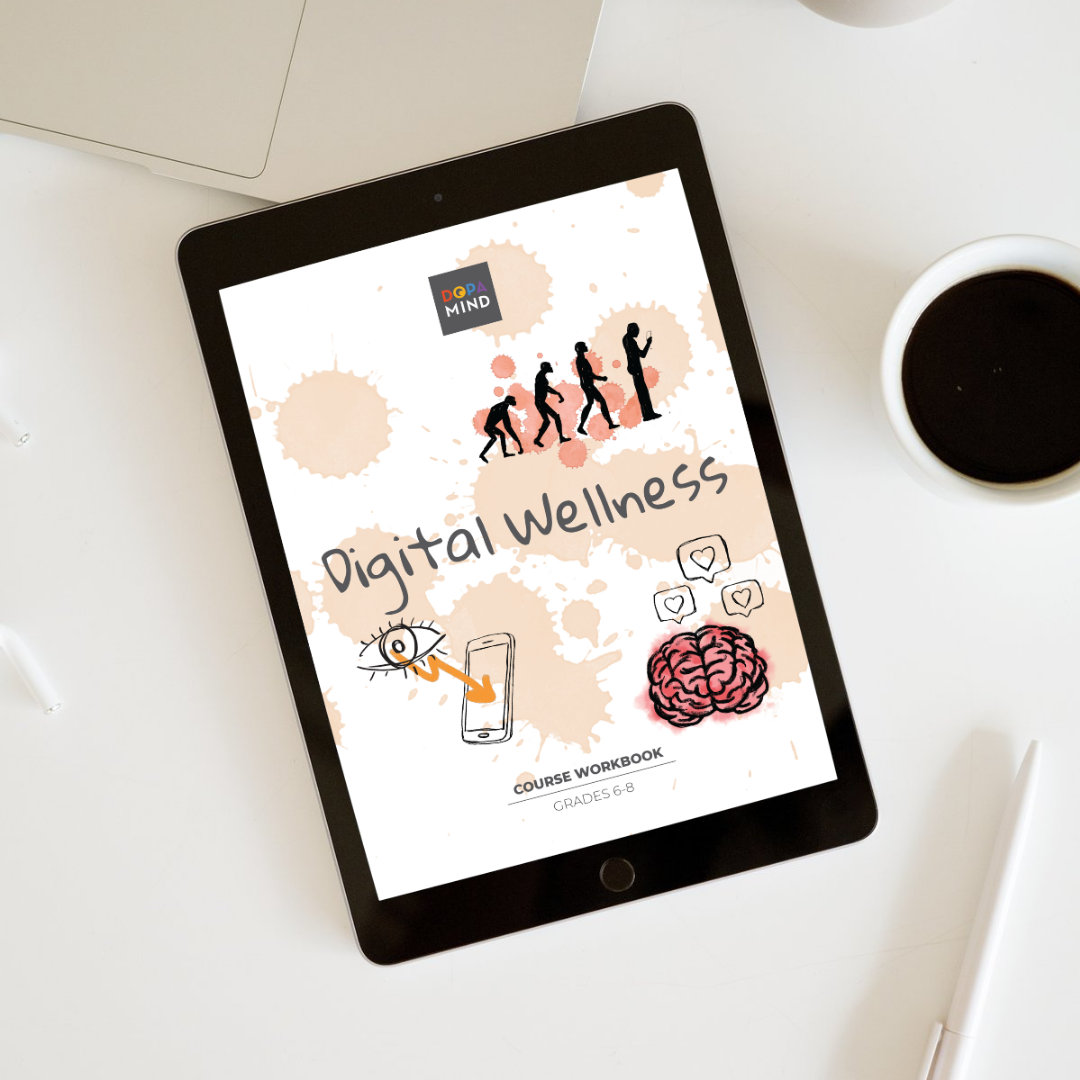
Our Digital Wellness Basics, Intermediate, and Advanced course workbook — lessons and activities combined into one download, for a single classroom. Personal and school license options also available.
Builds on Digital Wellness Grades TK–2 and 3–5 and adds our most in-depth unit yet — designed specifically for the middle school years. From foundational brain science to adolescent brain development, social media, video games, and the neurological effects of modern screen technology. The ideal companion to our Digital Wellness course lessons or online courses. Formatted for seamless printing at home or at your local print shop. Includes 42 presentation slides and 15 worksheets.
Learn the key evolutionary principles behind technology use, define dopamine, and understand the pleasure and pain principle including signs of dopamine deficit and overload.
Understand key adolescent brain changes including the role of the amygdala and prefrontal cortex and how technology intersects with FOMO, social comparison, and social exclusion.
Recognize how excessive technology use affects attention, memory, and critical thinking and identify signs of problematic tech use.
Learn the physical effects of modern screen technology, how it has evolved alongside adolescents, and how it affects learning and memory.
Explore the pros and cons of video games and social media, the differences between real and virtual relationships, and how gender and bias play into technology use.
Download the full material guide for a complete list of learning objectives.
Your purchase supports DopaMind's nonprofit mission — and if cost is ever a barrier, just ask. We believe every student deserves access to this education.
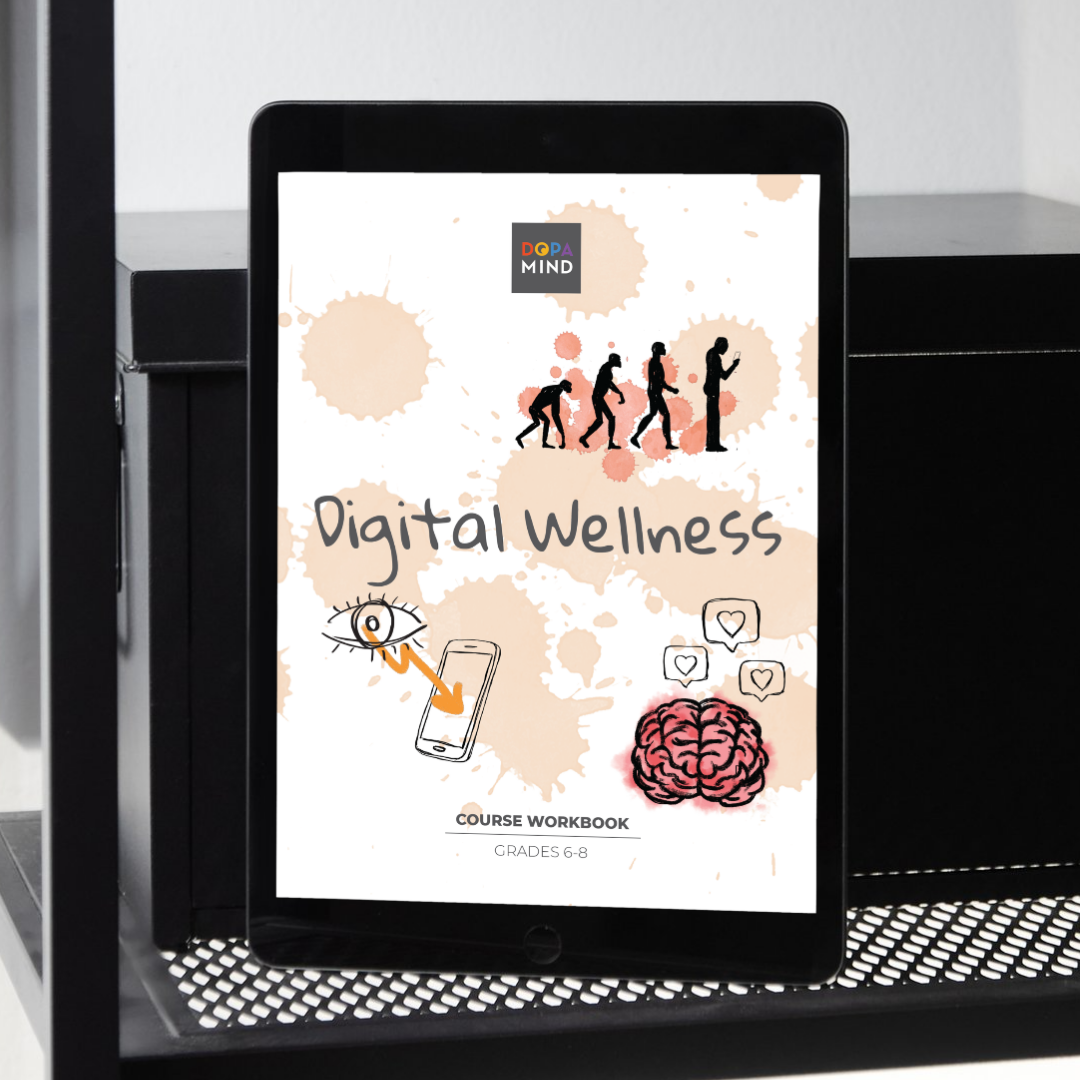
Our Digital Wellness Basics, Intermediate, and Advanced course workbook — lessons and activities combined into one download, for school-wide use across all classrooms. Personal and classroom license options also available.
Builds on Digital Wellness Grades TK–2 and 3–5 and adds our most in-depth unit yet — designed specifically for the middle school years. From foundational brain science to adolescent brain development, social media, video games, and the neurological effects of modern screen technology. The ideal companion to our Digital Wellness course lessons or online courses. Formatted for seamless printing at home or at your local print shop. Includes 42 presentation slides and 15 worksheets.
Learn the key evolutionary principles behind technology use, define dopamine, and understand the pleasure and pain principle including signs of dopamine deficit and overload.
Understand key adolescent brain changes including the role of the amygdala and prefrontal cortex and how technology intersects with FOMO, social comparison, and social exclusion.
Recognize how excessive technology use affects attention, memory, and critical thinking and identify signs of problematic tech use.
Learn the physical effects of modern screen technology, how it has evolved alongside adolescents, and how it affects learning and memory.
Explore the pros and cons of video games and social media, the differences between real and virtual relationships, and how gender and bias play into technology use.
Download the full material guide for a complete list of learning objectives.
Your purchase supports DopaMind's nonprofit mission — and if cost is ever a barrier, just ask. We believe every student deserves access to this education.
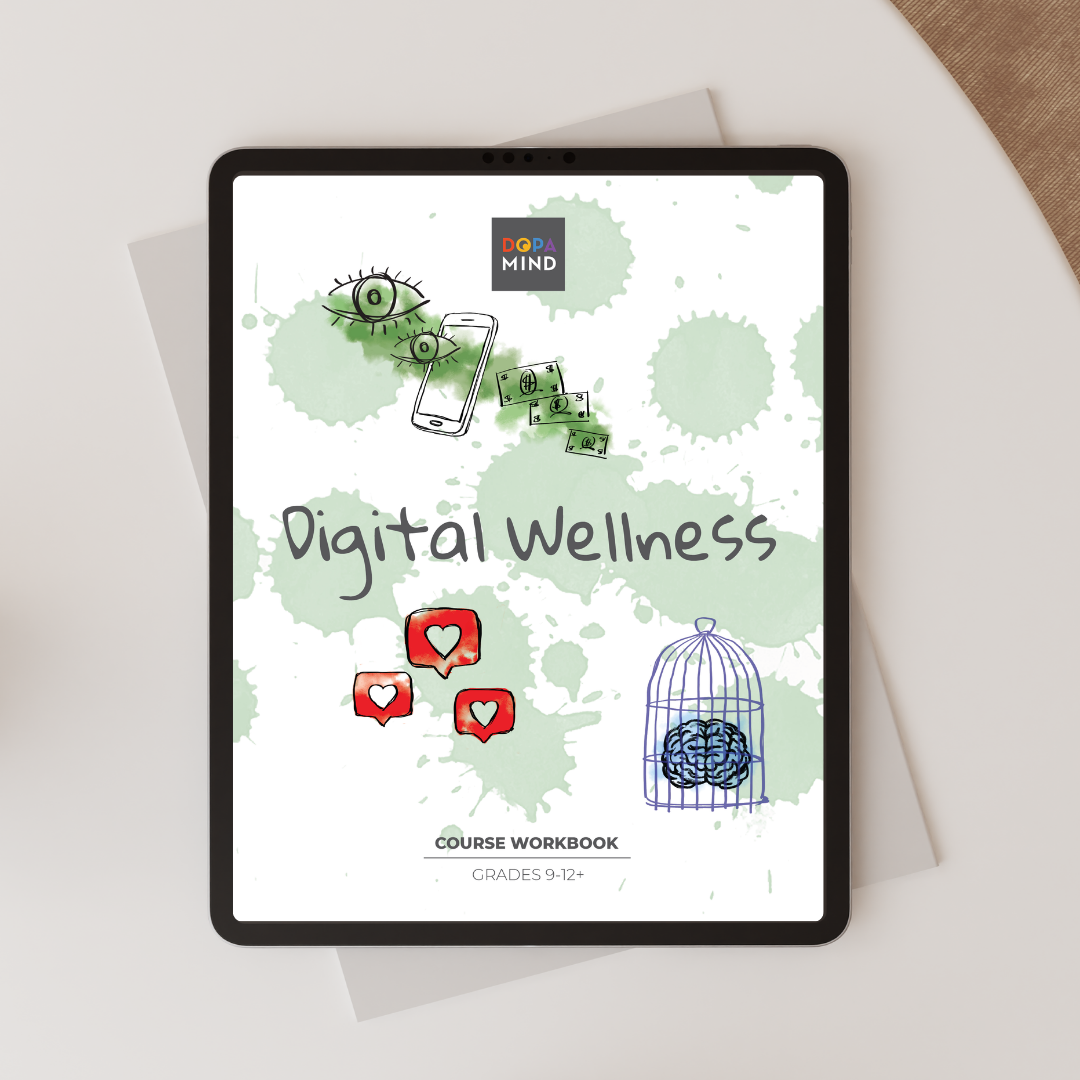
Our complete Digital Wellness course workbook including Basics, Intermediate, Advanced, and Master material — lessons and activities combined into one download, for individual parents and homeschool families. Classroom and school license options also available.
Builds on Digital Wellness Grades TK–2, 3–5, and 6–8 and adds our Master unit — our most sophisticated material, designed for high school and college students ready to think critically about technology's role in society. The ideal companion to our Digital Wellness course lessons or online courses. Formatted for seamless printing at home or at your local print shop. Includes 58 presentation slides and 18 worksheets.
Learn the key evolutionary principles behind technology use, define dopamine, and understand the pleasure and pain principle including signs of dopamine deficit and overload.
Understand key adolescent brain changes including the role of the amygdala and prefrontal cortex and how technology intersects with FOMO, social comparison, and social exclusion.
Recognize how excessive technology use affects attention, memory, and critical thinking and identify signs of problematic tech use.
Learn the physical effects of modern screen technology, how it has evolved alongside adolescents, and how it affects learning and memory.
Explore persuasive technology design, the attention economy, Big Tech legislation, loneliness, nomophobia, and what individuals and communities can do to create change.
Download the full material guide for a complete list of learning objectives.
Your purchase supports DopaMind's nonprofit mission — and if cost is ever a barrier, just ask. We believe every student deserves access to this education.
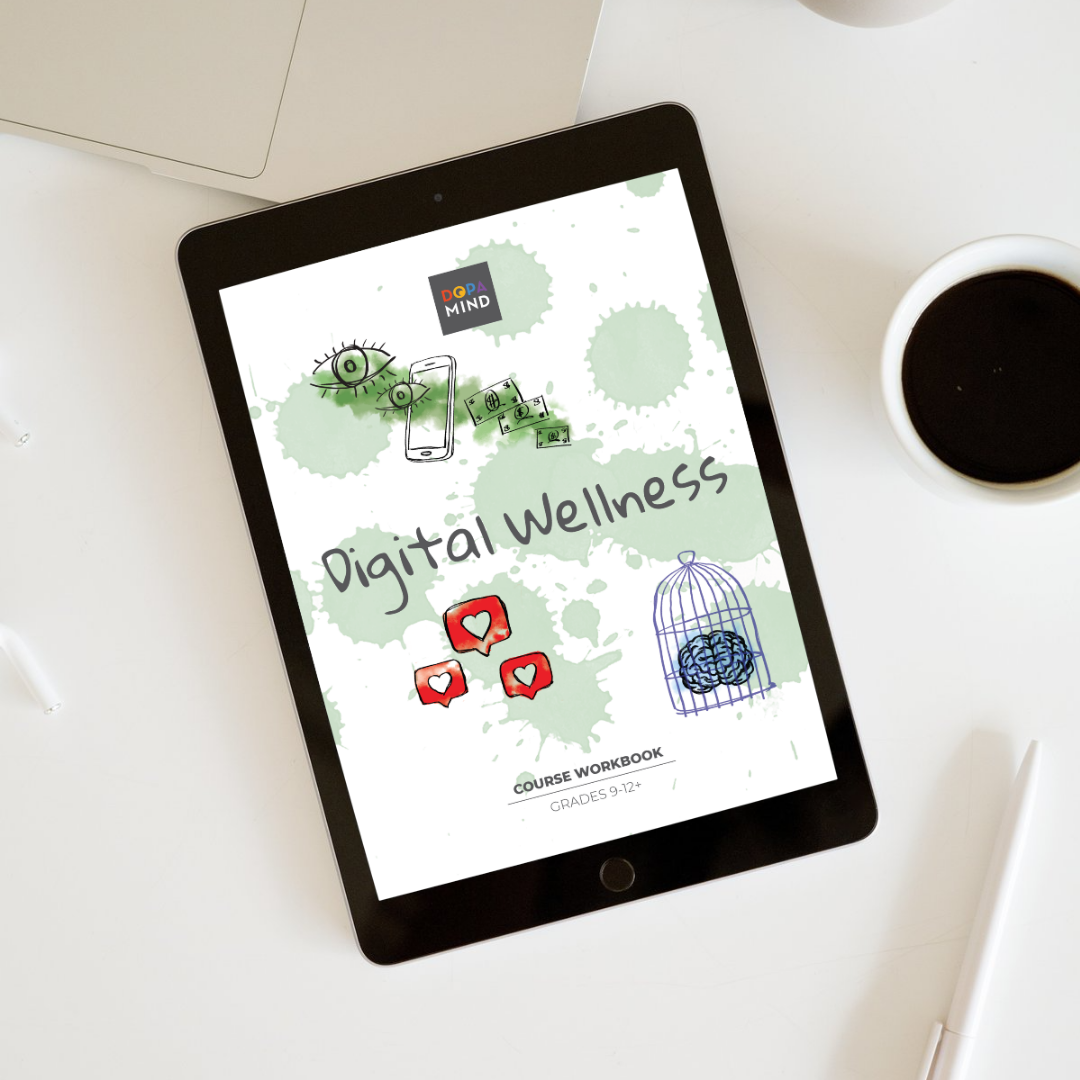
Our complete Digital Wellness course workbook including Basics, Intermediate, Advanced, and Master material — lessons and activities combined into one download, for a single classroom. Personal and school license options also available.
Builds on Digital Wellness Grades TK–2, 3–5, and 6–8 and adds our Master unit — our most sophisticated material, designed for high school and college students ready to think critically about technology's role in society. The ideal companion to our Digital Wellness course lessons or online courses. Formatted for seamless printing at home or at your local print shop. Includes 58 presentation slides and 18 worksheets.
Learn the key evolutionary principles behind technology use, define dopamine, and understand the pleasure and pain principle including signs of dopamine deficit and overload.
Understand key adolescent brain changes including the role of the amygdala and prefrontal cortex and how technology intersects with FOMO, social comparison, and social exclusion.
Recognize how excessive technology use affects attention, memory, and critical thinking and identify signs of problematic tech use.
Learn the physical effects of modern screen technology, how it has evolved alongside adolescents, and how it affects learning and memory.
Explore persuasive technology design, the attention economy, Big Tech legislation, loneliness, nomophobia, and what individuals and communities can do to create change.
Download the full material guide for a complete list of learning objectives.
Your purchase supports DopaMind's nonprofit mission — and if cost is ever a barrier, just ask. We believe every student deserves access to this education.
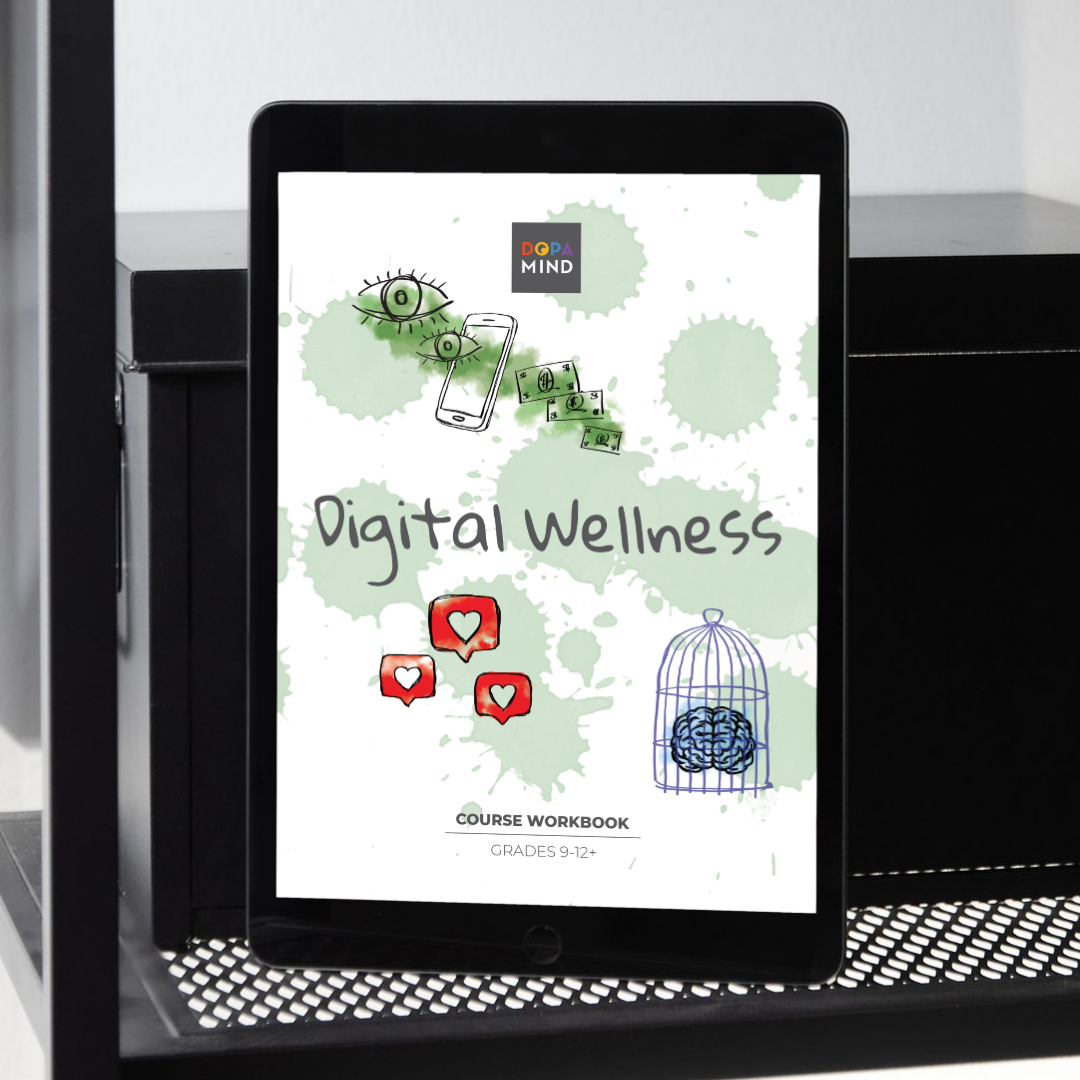
Our complete Digital Wellness course workbook including Basics, Intermediate, Advanced, and Master material — lessons and activities combined into one download, for school-wide use across all classrooms. Personal and classroom license options also available.
Builds on Digital Wellness Grades TK–2, 3–5, and 6–8 and adds our Master unit — our most sophisticated material, designed for high school and college students ready to think critically about technology's role in society. The ideal companion to our Digital Wellness course lessons or online courses. Formatted for seamless printing at home or at your local print shop. Includes 58 presentation slides and 18 worksheets.
Learn the key evolutionary principles behind technology use, define dopamine, and understand the pleasure and pain principle including signs of dopamine deficit and overload.
Understand key adolescent brain changes including the role of the amygdala and prefrontal cortex and how technology intersects with FOMO, social comparison, and social exclusion.
Recognize how excessive technology use affects attention, memory, and critical thinking and identify signs of problematic tech use.
Learn the physical effects of modern screen technology, how it has evolved alongside adolescents, and how it affects learning and memory.
Explore persuasive technology design, the attention economy, Big Tech legislation, loneliness, nomophobia, and what individuals and communities can do to create change.
Download the full material guide for a complete list of learning objectives.
Your purchase supports DopaMind's nonprofit mission — and if cost is ever a barrier, just ask. We believe every student deserves access to this education.
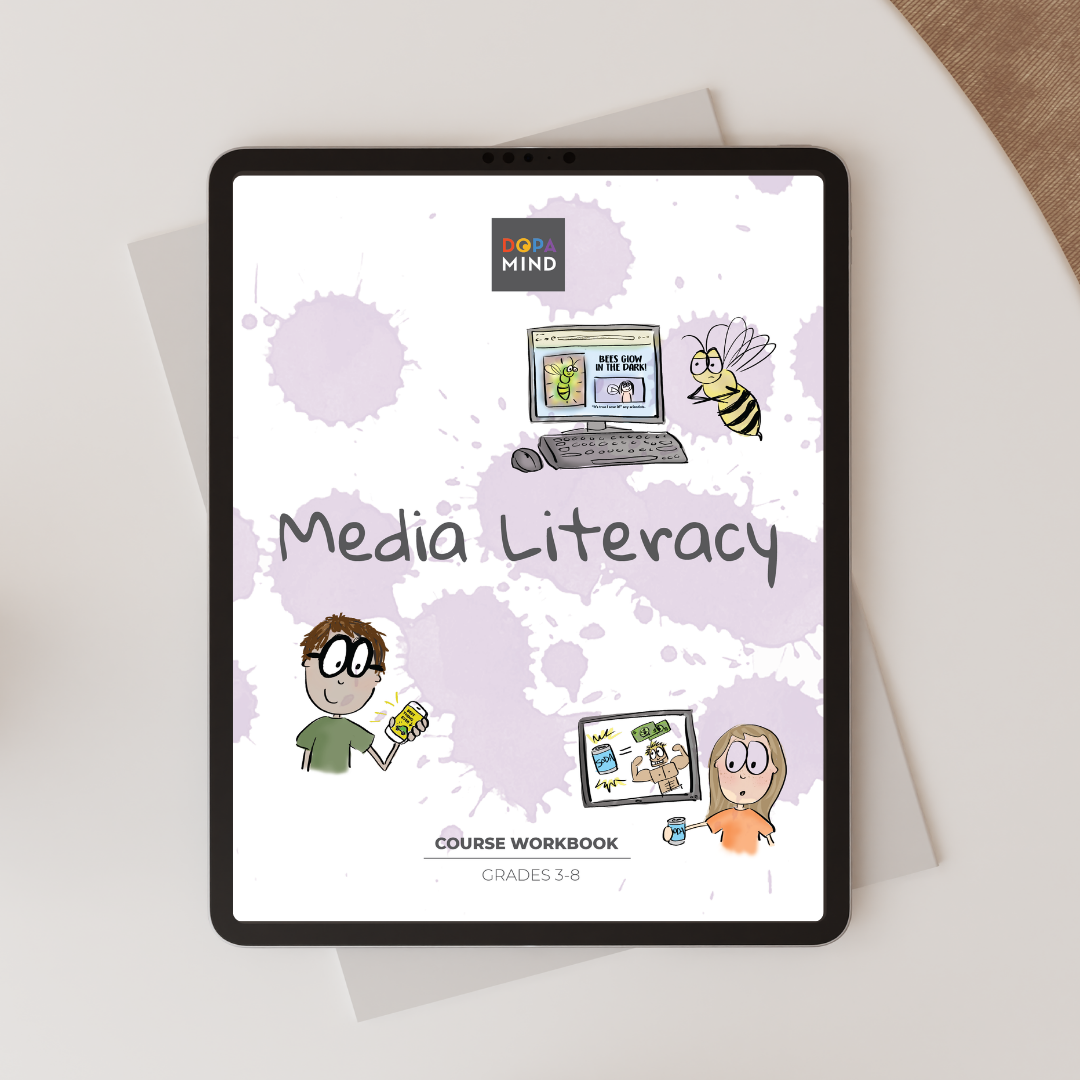
Our Media Literacy course workbook — lessons and activities combined into one download, for individual parents and homeschool families. Classroom and school license options also available.
Designed to follow Digital Wellness but equally effective as a standalone unit. Students develop the critical thinking skills needed to navigate today's information landscape — learning to analyze how media messages are constructed, spot misleading content and advertising, and apply a principle of inquiry to everything they see, hear, and share online. The ideal companion to our Media Literacy course lessons or online courses. Formatted for seamless printing at home or at your local print shop. Includes 8 presentation slides and 8 worksheets.
Identify different types of media messages and understand how they are produced.
Understand the verbal, aural, and visual aspects of media messages and how they shape perception of reality.
Differentiate between media sources and producers.
Navigate online content on search engines and websites and learn to differentiate between true and false information.
Understand the principle of inquiry regarding seen, heard, produced, and engaged content.use.
Download the full material guide for lower or middle school for a complete list of learning objectives.
Your purchase supports DopaMind's nonprofit mission — and if cost is ever a barrier, just ask. We believe every student deserves access to this education.
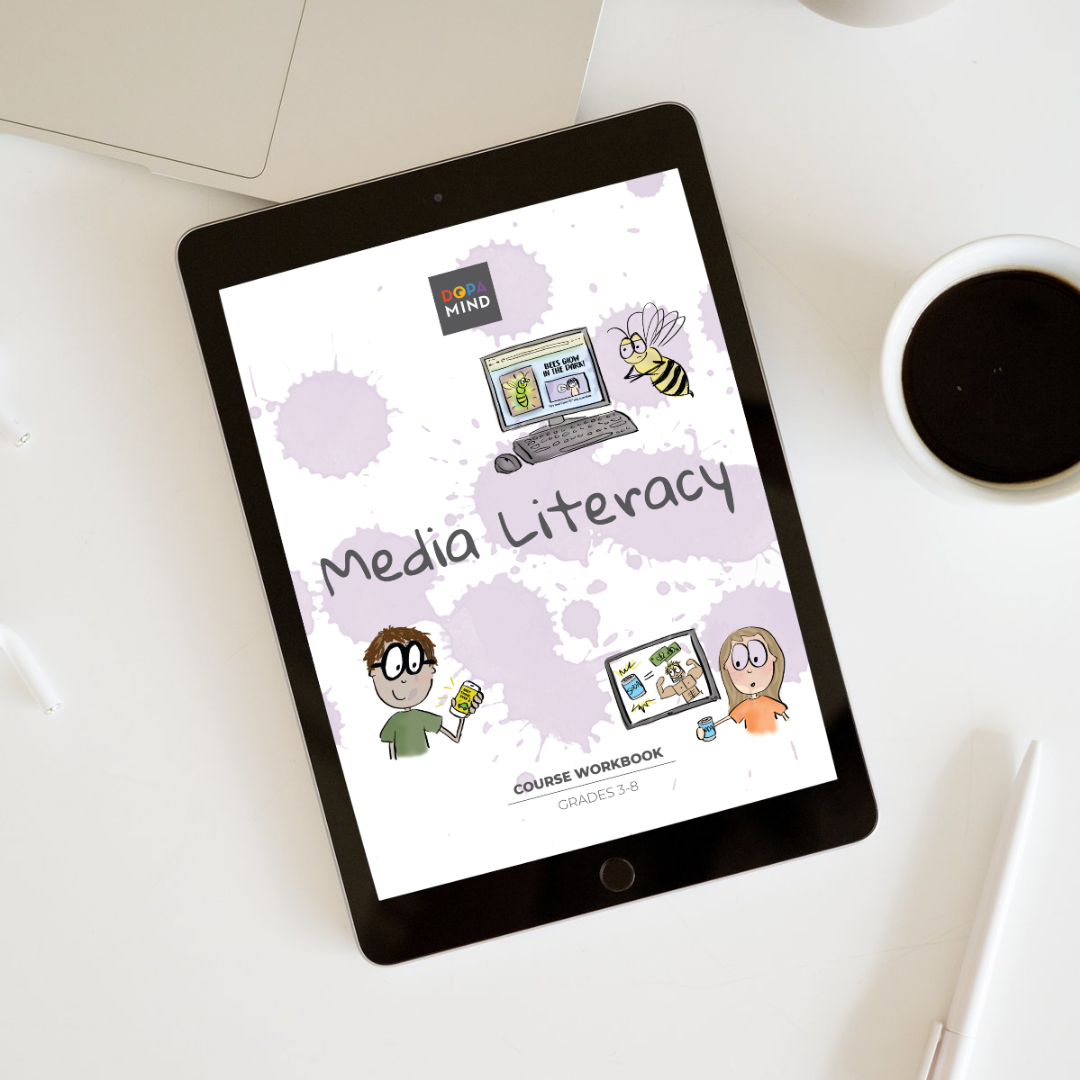
Our Media Literacy course workbook — lessons and activities combined into one download, for a single classroom. Personal and school license options also available.
Designed to follow Digital Wellness but equally effective as a standalone unit. Students develop the critical thinking skills needed to navigate today's information landscape — learning to analyze how media messages are constructed, spot misleading content and advertising, and apply a principle of inquiry to everything they see, hear, and share online. The ideal companion to our Media Literacy course lessons or online courses. Formatted for seamless printing at home or at your local print shop. Includes 8 presentation slides and 8 worksheets.
Identify different types of media messages and understand how they are produced.
Understand the verbal, aural, and visual aspects of media messages and how they shape perception of reality.
Differentiate between media sources and producers.
Navigate online content on search engines and websites and learn to differentiate between true and false information.
Understand the principle of inquiry regarding seen, heard, produced, and engaged content.use.
Download the full material guide for lower or middle school for a complete list of learning objectives.
Your purchase supports DopaMind's nonprofit mission — and if cost is ever a barrier, just ask. We believe every student deserves access to this education.
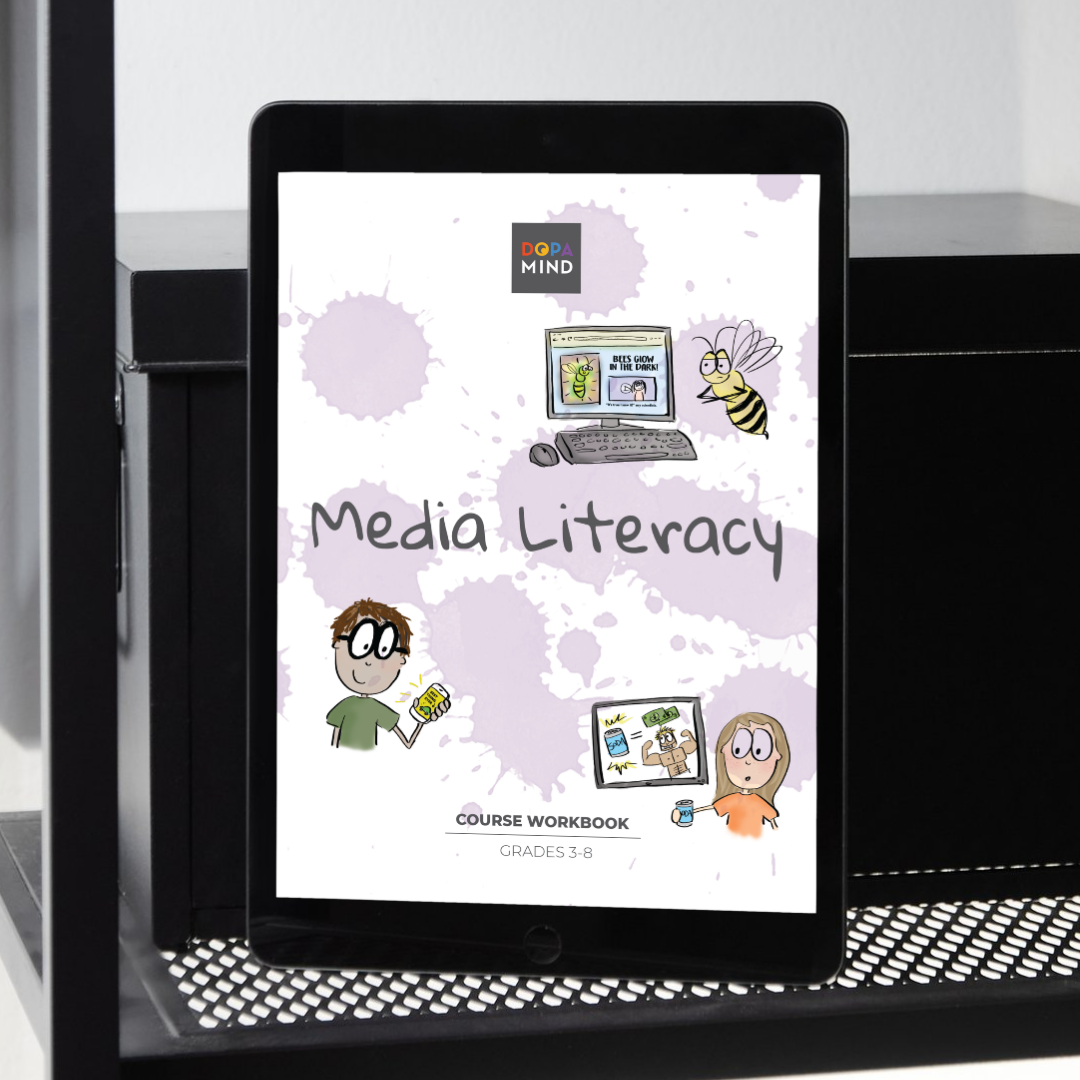
Our Media Literacy course workbook — lessons and activities combined into one download, for school-wide use across all classrooms. Personal and classroom license options also available.
Designed to follow Digital Wellness but equally effective as a standalone unit. Students develop the critical thinking skills needed to navigate today's information landscape — learning to analyze how media messages are constructed, spot misleading content and advertising, and apply a principle of inquiry to everything they see, hear, and share online. The ideal companion to our Media Literacy course lessons or online courses. Formatted for seamless printing at home or at your local print shop. Includes 8 presentation slides and 8 worksheets.
Identify different types of media messages and understand how they are produced.
Understand the verbal, aural, and visual aspects of media messages and how they shape perception of reality.
Differentiate between media sources and producers.
Navigate online content on search engines and websites and learn to differentiate between true and false information.
Understand the principle of inquiry regarding seen, heard, produced, and engaged content.use.
Download the full material guide for lower or middle school for a complete list of learning objectives.
Your purchase supports DopaMind's nonprofit mission — and if cost is ever a barrier, just ask. We believe every student deserves access to this education.
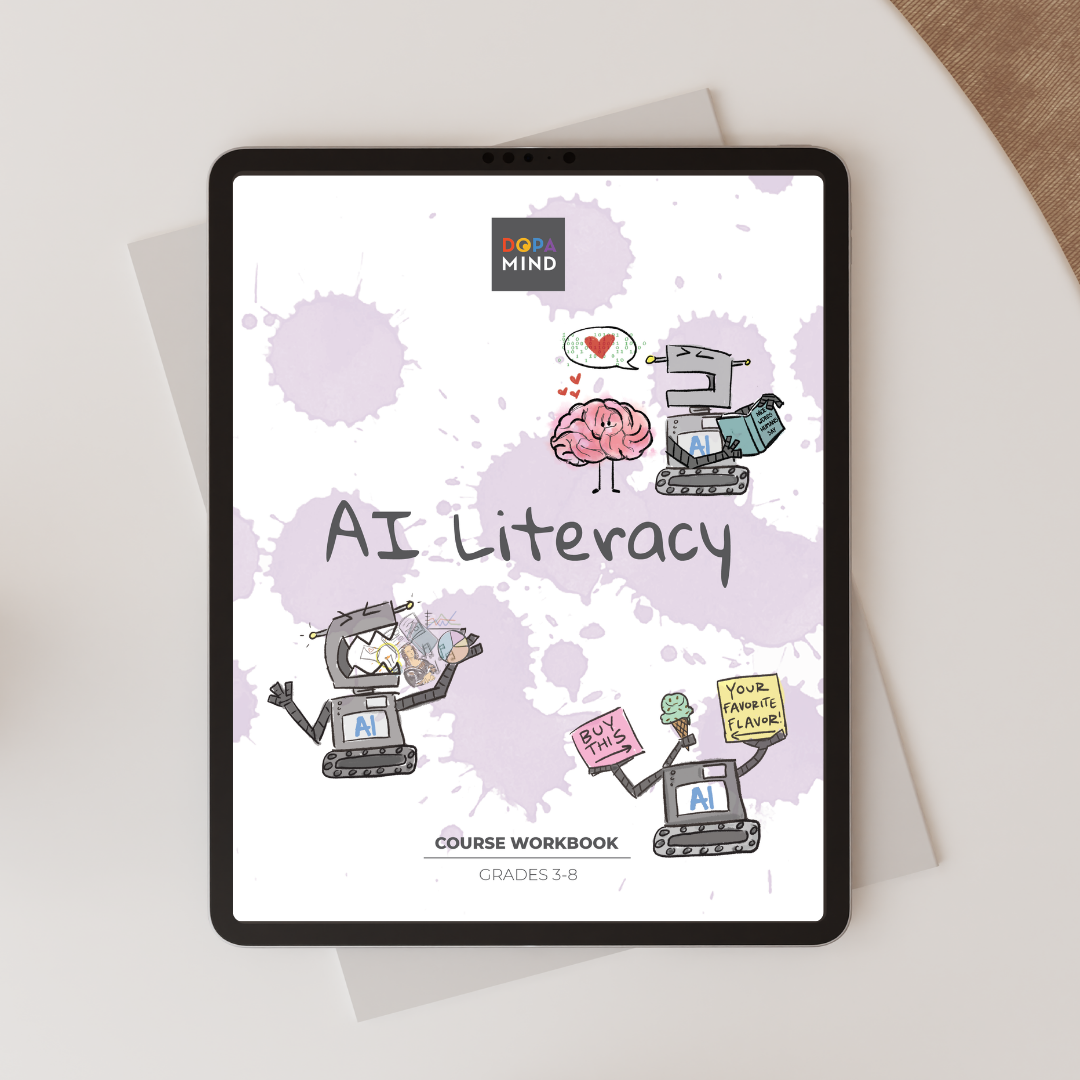
Our AI Literacy course workbook — lessons and activities combined into one download, for individual parents and homeschool families. Classroom and school license options also available.
Designed to follow Digital Wellness and Media Literacy courses but equally effective as a standalone unit. As artificial intelligence rapidly transforms childhood and education, students need a foundation to understand it. This unit covers what AI is, how it learns, its history, limitations, risks, and benefits — empowering students to think critically about AI's role in their lives and why adult guidance matters. The ideal companion to our AI Literacy course lessons or online courses. Formatted for seamless printing at home or at your local print shop. Includes 11 presentation slides and 11 worksheets.
Understand what AI is and how it differs from other technologies.
Identify where AI appears in daily life, from voice assistants to recommendation algorithms.
Learn the history of AI, how it's developed, and how it learns and evolves.
Recognize AI's limitations including hallucinations, bias, and mistakes.
Explore how AI helps and hurts individuals and society, including privacy concerns, job displacement, and impacts on thinking and relationships.
Learn why adult guidance is important when encountering AI tools and develop critical thinking skills for understanding AI's role in the world.
Download the full material guide for lower or middle school for a complete list of learning objectives.
Your purchase supports DopaMind's nonprofit mission — and if cost is ever a barrier, just ask. We believe every student deserves access to this education.
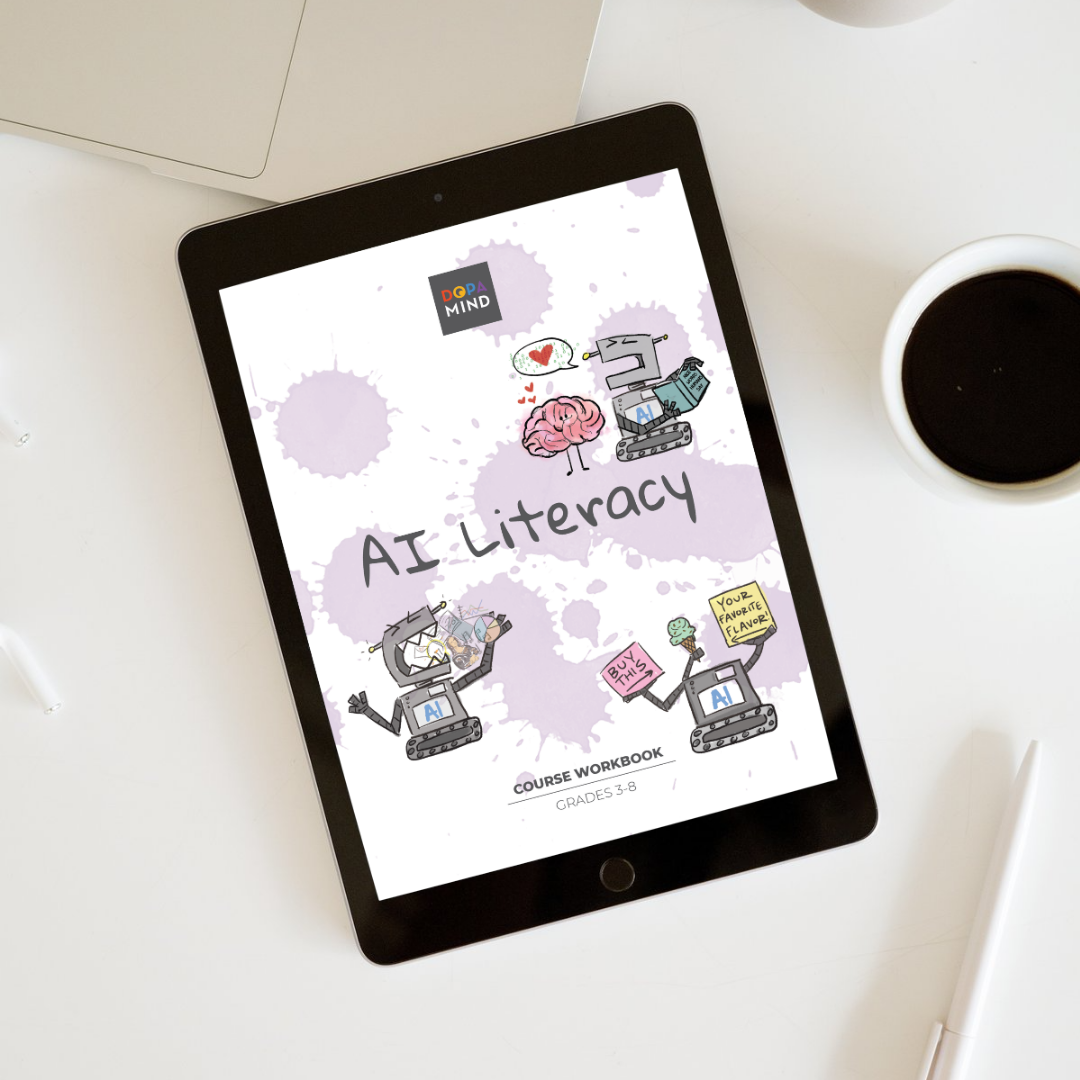
Our AI Literacy course workbook — lessons and activities combined into one download, for a single classroom. Personal and school license options also available.
Designed to follow Digital Wellness and Media Literacy courses but equally effective as a standalone unit. As artificial intelligence rapidly transforms childhood and education, students need a foundation to understand it. This unit covers what AI is, how it learns, its history, limitations, risks, and benefits — empowering students to think critically about AI's role in their lives and why adult guidance matters. The ideal companion to our AI Literacy course lessons or online courses. Formatted for seamless printing at home or at your local print shop. Includes 11 presentation slides and 11 worksheets.
Understand what AI is and how it differs from other technologies.
Identify where AI appears in daily life, from voice assistants to recommendation algorithms.
Learn the history of AI, how it's developed, and how it learns and evolves.
Recognize AI's limitations including hallucinations, bias, and mistakes.
Explore how AI helps and hurts individuals and society, including privacy concerns, job displacement, and impacts on thinking and relationships.
Learn why adult guidance is important when encountering AI tools and develop critical thinking skills for understanding AI's role in the world.
Download the full material guide for lower or middle school for a complete list of learning objectives.
Your purchase supports DopaMind's nonprofit mission — and if cost is ever a barrier, just ask. We believe every student deserves access to this education.
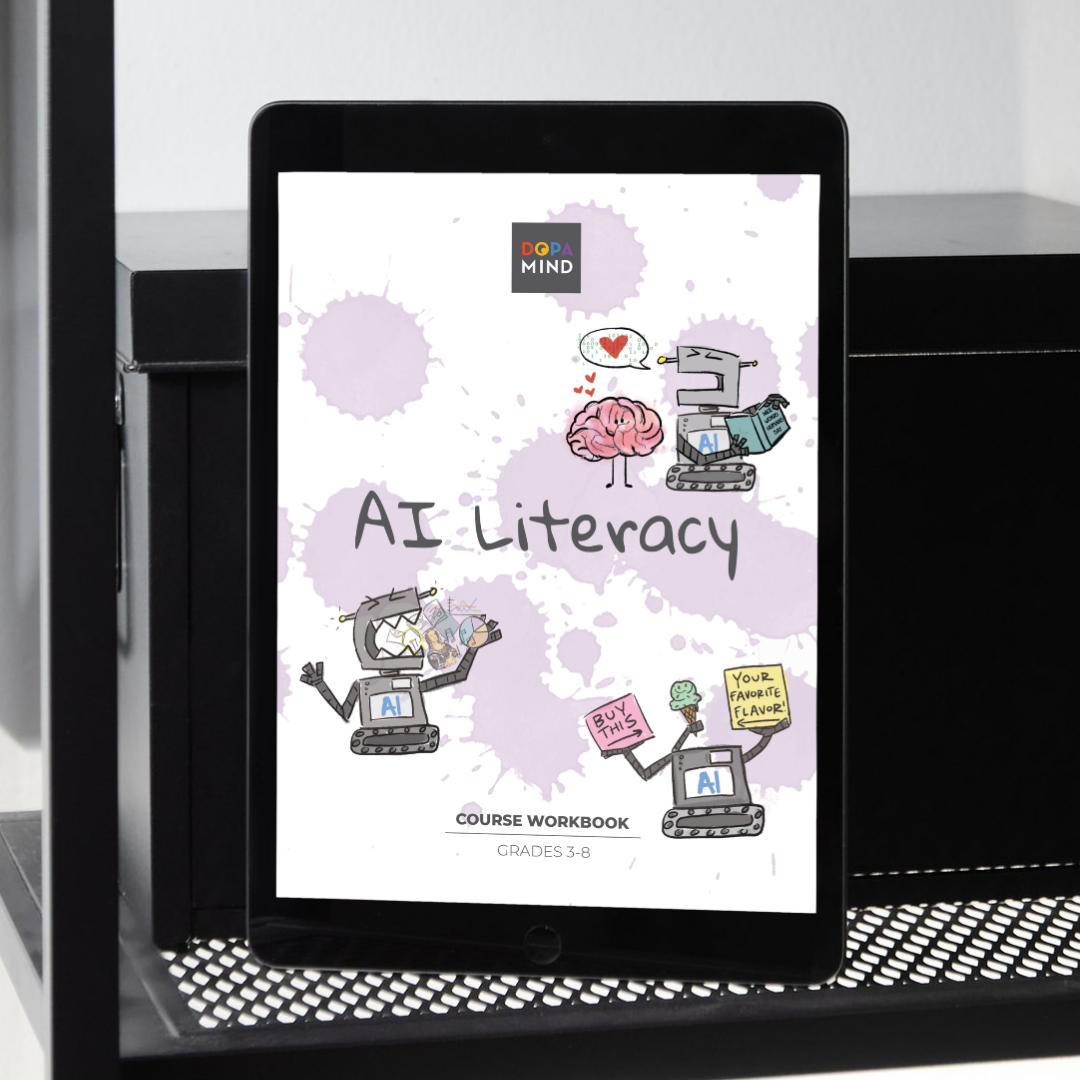
Our AI Literacy course workbook — lessons and activities combined into one download, for school-wide use across all classrooms. Personal and classroom license options also available.
Designed to follow Digital Wellness and Media Literacy courses but equally effective as a standalone unit. As artificial intelligence rapidly transforms childhood and education, students need a foundation to understand it. This unit covers what AI is, how it learns, its history, limitations, risks, and benefits — empowering students to think critically about AI's role in their lives and why adult guidance matters. The ideal companion to our AI Literacy course lessons or online courses. Formatted for seamless printing at home or at your local print shop. Includes 11 presentation slides and 11 worksheets.
Understand what AI is and how it differs from other technologies.
Identify where AI appears in daily life, from voice assistants to recommendation algorithms.
Learn the history of AI, how it's developed, and how it learns and evolves.
Recognize AI's limitations including hallucinations, bias, and mistakes.
Explore how AI helps and hurts individuals and society, including privacy concerns, job displacement, and impacts on thinking and relationships.
Learn why adult guidance is important when encountering AI tools and develop critical thinking skills for understanding AI's role in the world.
Download the full material guide for lower or middle school for a complete list of learning objectives.
Your purchase supports DopaMind's nonprofit mission — and if cost is ever a barrier, just ask. We believe every student deserves access to this education.
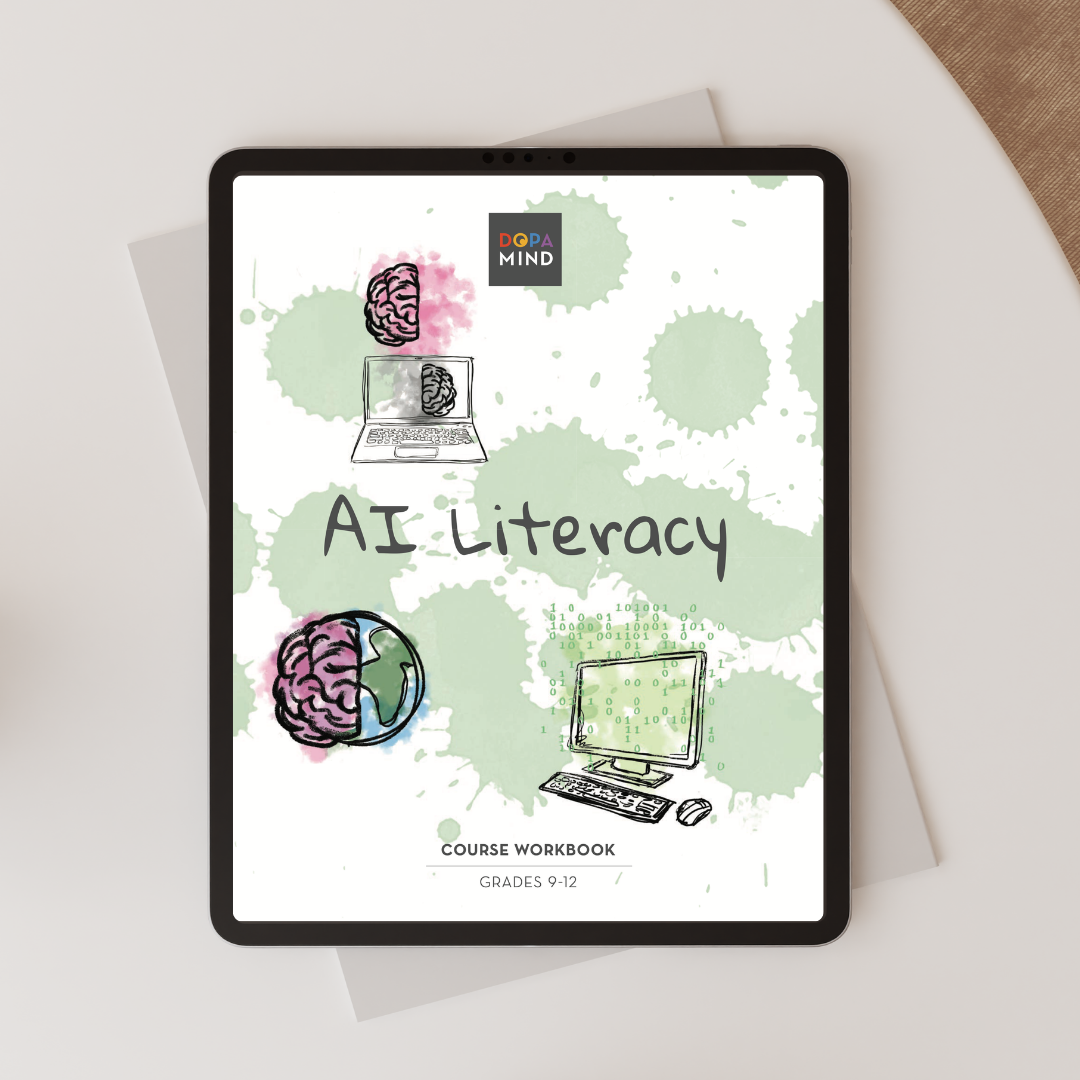
Our AI Literacy course workbook for high school and college — lessons and activities combined into one download, for individual parents and homeschool families. Classroom and school license options also available.
Designed to follow Digital Wellness courses but equally effective as a standalone unit. As artificial intelligence rapidly transforms education and the workforce, high school and college students need more than a basic understanding of AI — they need the critical thinking and human skills to navigate it confidently. The ideal companion to our AI Literacy course lessons or online courses. Formatted for seamless printing at home or at your local print shop. Includes 23 presentation slides and 4 worksheets.
Understand what AI is and how it differs from traditional computer programs, and learn the history of AI and what made the rapid rise of generative AI possible.
Learn the difference between traditional, generative, and agentic AI and where each appears in today's world.
Understand how large language models are trained and why they demonstrate bias and hallucinations.
Explore how AI is helping society through medicine, science, and accessibility — and how it can hurt through job displacement, deepfakes, AI slop, and cognitive offloading.
Understand academic integrity and plagiarism risks of AI use in school and the workforce, and develop the critical thinking and human skills that will matter most in an AI-driven future.
Download the full material guide for a complete list of learning objectives.
Your purchase supports DopaMind's nonprofit mission — and if cost is ever a barrier, just ask. We believe every student deserves access to this education.

Our AI Literacy course workbook for high school and college — lessons and activities combined into one download, for a single classroom. Personal and school license options also available.
Designed to follow Digital Wellness courses but equally effective as a standalone unit. As artificial intelligence rapidly transforms education and the workforce, high school and college students need more than a basic understanding of AI — they need the critical thinking and human skills to navigate it confidently. The ideal companion to our AI Literacy course lessons or online courses. Formatted for seamless printing at home or at your local print shop. Includes 23 presentation slides and 4 worksheets.
Understand what AI is and how it differs from traditional computer programs, and learn the history of AI and what made the rapid rise of generative AI possible.
Learn the difference between traditional, generative, and agentic AI and where each appears in today's world.
Understand how large language models are trained and why they demonstrate bias and hallucinations.
Explore how AI is helping society through medicine, science, and accessibility — and how it can hurt through job displacement, deepfakes, AI slop, and cognitive offloading.
Understand academic integrity and plagiarism risks of AI use in school and the workforce, and develop the critical thinking and human skills that will matter most in an AI-driven future.
Download the full material guide for a complete list of learning objectives.
Your purchase supports DopaMind's nonprofit mission — and if cost is ever a barrier, just ask. We believe every student deserves access to this education.
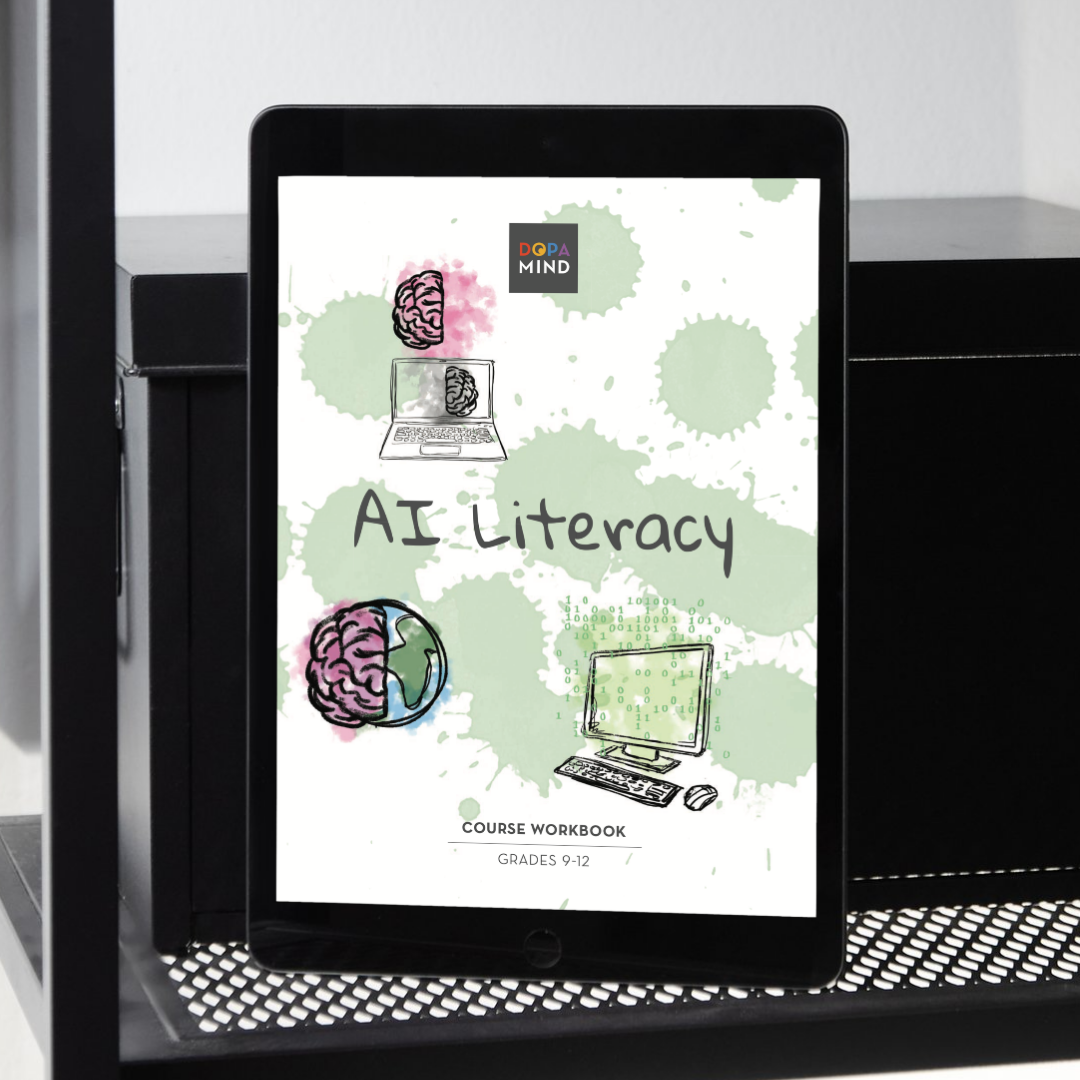
Our AI Literacy course workbook for high school and college — lessons and activities combined into one download, for school-wide use across all classrooms. Personal and classroom license options also available.
Designed to follow Digital Wellness courses but equally effective as a standalone unit. As artificial intelligence rapidly transforms education and the workforce, high school and college students need more than a basic understanding of AI — they need the critical thinking and human skills to navigate it confidently. The ideal companion to our AI Literacy course lessons or online courses. Formatted for seamless printing at home or at your local print shop. Includes 23 presentation slides and 4 worksheets.
Understand what AI is and how it differs from traditional computer programs, and learn the history of AI and what made the rapid rise of generative AI possible.
Learn the difference between traditional, generative, and agentic AI and where each appears in today's world.
Understand how large language models are trained and why they demonstrate bias and hallucinations.
Explore how AI is helping society through medicine, science, and accessibility — and how it can hurt through job displacement, deepfakes, AI slop, and cognitive offloading.
Understand academic integrity and plagiarism risks of AI use in school and the workforce, and develop the critical thinking and human skills that will matter most in an AI-driven future.
Download the full material guide for a complete list of learning objectives.
Your purchase supports DopaMind's nonprofit mission — and if cost is ever a barrier, just ask. We believe every student deserves access to this education.
Get a Free Lesson from Each Course